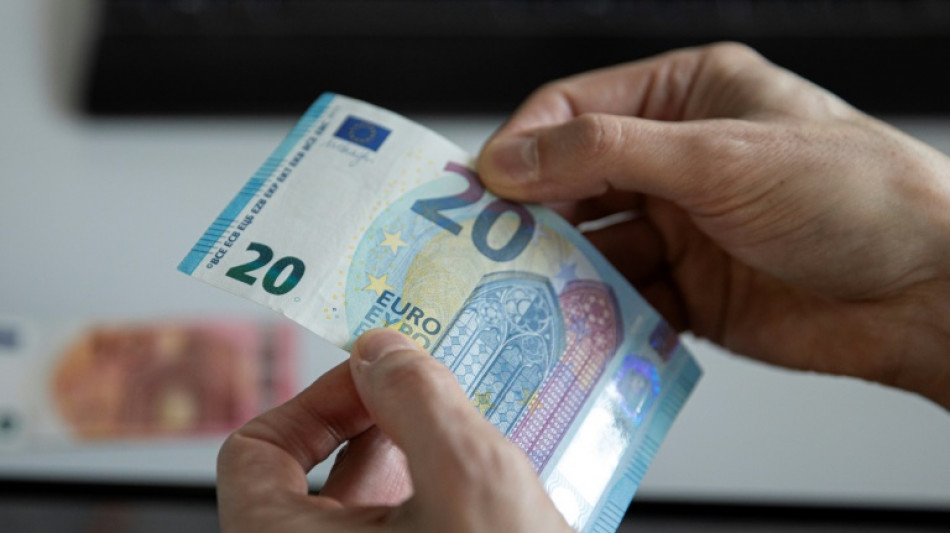
Eurozone economy hit by Ukraine war fallout / Photo: ANDRE PAIN - AFP/File

 Nintendo producer 'all nervous' as Zelda classic remake hits shelves

 Three killed by storm in southern India

 Two hundred 'Cruise for life' passengers stranded in Cambodia

 Billionaire Ambani's Jio jumps 21% in market debut after record India IPO

 Sri Lanka's Tamil farmers fight to reclaim land after civil war

 'They don't care about us': Trump food aid cuts leave Americans struggling and angry

 Palestinian activist Khalil returns to Columbia after US detention

 Youths testify about 'despair' in unprecedented Canadian climate trial

 Storied Paris department store seeks bankruptcy protection

 Boeing shares tumble after it releases cautious growth forecast

The eurozone economy felt the fallout from the Ukraine war as output slowed and inflation stayed at record levels in the first quarter, official data showed Friday, imperilling Europe's recovery from the pandemic.
The EU's official statistics agency said that growth in the 19 countries that use the euro crawled to 0.2 percent between January and March compared to the previous quarter.
It was down from 0.3 percent in the final quarter of 2021.
For the European Union as a whole, gross domestic product grew by 0.4 percent in the first quarter, after 0.5 percent in the last three months of 2021.
Among the major countries, Spain and Germany saw their economies grow by 0.3 percent and 0.2 percent respectively in the first three months of the year. France was flat and Italy down, minus 0.2 percent.
The small increase in eurozone growth "means that the region will avoid a technical recession in the first half of the year at least," said Andrew Kenningham, Chief Europe Economist at Capital Economics.
"But rising inflation and the fallout from the Ukraine war mean that GDP is likely to contract in the next quarter," he said.
- Price shock -
Compared to a year ago, the growth level in Europe still remained high, coming off the big crashes in GDP because of the coronavirus pandemic that put the global economy on its knees.
This meant that the growth rate year-on-year was up a solid five percent for the eurozone, and 5.2 percent for the wider EU, compared to the first quarter of 2021.
The big shock remains consumer prices, with the economy handicapped by the rise in consumer prices, especially in the energy sector because of the war in Ukraine.
Consumer prices in the eurozone soared by a record 7.5 percent in April, up from a revised 7.4 percent the month before, Eurostat said.
These figures are the highest recorded by the European statistics office since the publication of this indicator began in January 1997.
Inflation has broken a new record each month since November, though the leap in April was more moderate than previous months.
In April, the highest rate of increase was recorded for energy prices, which was up by 38 percent. This increase was slightly slower compared to March when it reached 44 percent.
H.Cho--CPN