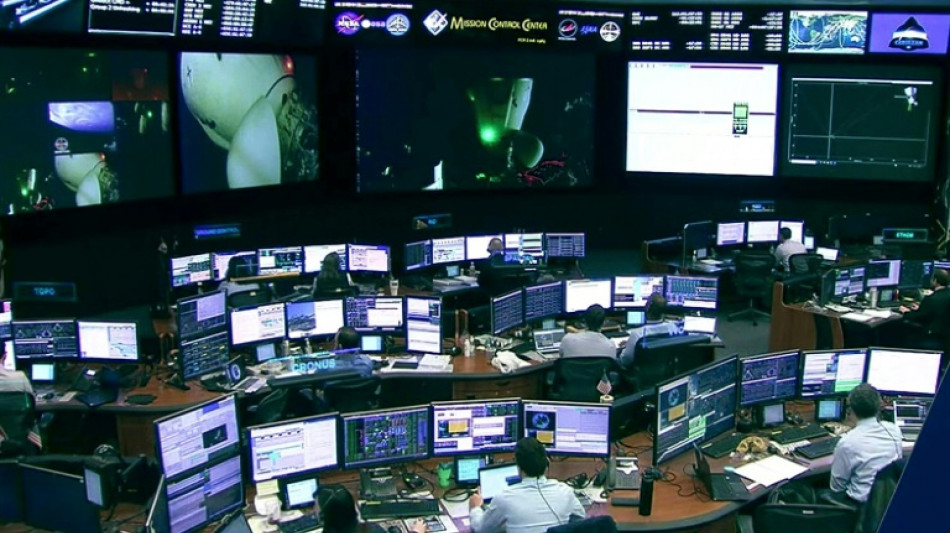
Crew of first private flight to ISS return to Earth / Photo: Handout - NASA TV/AFP

 Billionaire Ambani's Jio soars in market debut after India's biggest IPO

 AI chip giant SK hynix posts seven-fold surge in quarterly operating profit

 S.African activists push back on data centre rush

 Billionaire Ambani's Jio to debut after record India IPO

 UK set for cautious budget as borrowing costs climb

 US Fed expected to hold rates steady ahead of key midterm elections

 AI chip giant SK hynix says quarterly operating profit soars 630%

 Charles tackles thorny legacy of slavery on Caribbean trip

 UN nuclear watchdog chief urges Iran to grant access

 Boeing releases cautious growth plan as shares fall sharply

 Tech firms gain on Anthropic IPO optimism; HSBC slumps in London
Three businessmen and a former NASA astronaut splashed down Monday off the Florida coast after spending two weeks aboard the International Space Station in a landmark mission for the commercial sector.
After a dizzying descent, a SpaceX Dragon capsule carrying the Axiom-1 gently floated down to the Atlantic Ocean near Jacksonville at 1:06 pm (1706 GMT) on four huge parachutes.
"Dragon Endeavor has returned home with the Axiom-1 Crew," said an announcer, as a recovery vessel made its way to the capsule.
The spaceship was affectionately referred to as a "toasted marshmallow" because of the scorch marks on its heat shield from re-entering the atmosphere at 17,500 miles per hour (28,000 km/h).
It marks the official end of the first fully-private mission to the orbiting outpost -- and a turning point in US space agency NASA's goal to commercialize the region of space called low Earth orbit.
"Welcome home, Axiom-1!" tweeted NASA chief Bill Nelson. "#Ax1 and all of the progress we've seen in the commercial space sector wouldn't be possible without NASA's collaboration with private industry."
Axiom Space paid SpaceX for transport services and NASA for use of the ISS, while charging the three tycoons a reported $55 million each for the privilege.
American real estate mogul Larry Connor, Canadian financier Mark Pathy and Israeli impact investor Eytan Stibbe and veteran Spanish-American astronaut Michael Lopez-Alegria had blasted off on April 8.
They were originally scheduled to spend only eight days on the space station but bad weather forced repeated delays. In total, the crew spent 17 days in orbit, 15 of those on the ISS.
- Research, not tourism -
Axiom had been keen to stress its mission shouldn't be considered tourism, unlike the recent, attention-grabbing suborbital flights carried out by Blue Origin and Virgin Galactic.
On board the ISS, which orbits 250 miles (400 kilometers) above sea level, the quartet carried out research projects, including an MIT technology demonstration of smart tiles that form a robotic swarm and self-assemble into space architecture.
Another experiment involved using cancer stem cells to grow mini tumors, then leveraging the accelerated aging environment of microgravity to identify early changes in those tumors, to help improve screening methods.
Pathy spent considerable time in the station's famous observation cupola, photographing Earth.
NASA has already given the green light, in principle, to a second mission: Ax-2.
The departure of the Ax-1 crew left seven people on the ISS: three Americans, a German and three Russians.
Monday's sea landing of a manned SpaceX Dragon capsule was the fifth to date.
SpaceX, owned by billionaire entrepreneur Elon Musk, is now regularly ferrying NASA astronauts to and from the space station.
Last year, Musk's company launched another entirely private mission, which orbited Earth for three days without linking up with the ISS.
Axiom sees the voyages as the first steps of a grander goal: to build its own private space station. The first module is due to launch in 2024.
The plan is for the station to initially be attached to the ISS, before eventually flying autonomously when the latter retires and is deorbited sometime after 2030.
M.P.Jacobs--CPN
