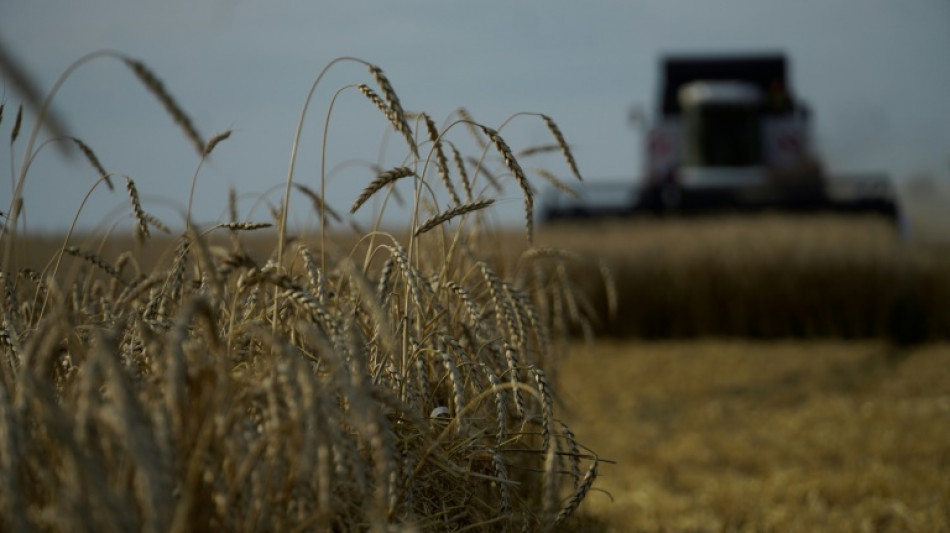
EU states agree 'prohibitive' tariffs on Russia grain imports / Photo: STRINGER - AFP/File

 India seeks threefold increase in coal stocks to prevent summer power shortages

 Indus Towers expands solar-powered network to 50,000 telecom sites

 Equitas Small Finance Bank rebounds after naming interim chief executive

 Titan quarterly profit seen rising as jewellery business drives growth

 Kuwait finance minister holds economic cooperation talks at COMCEC

 Kuwait marks key events and anniversaries from national history

 Qatar media bodies discuss support for humanitarian initiatives

EU states agreed on Thursday to impose "prohibitive" duties on grain imports from Russia in a bid to cut off revenues to Moscow for its war on Ukraine.
The European Union has hit Russia with multiple rounds of sanctions to inflict damage on Russia's war chest following its all-out invasion of Ukraine in 2022.
The latest measure will "tackle illegal Russian exports of stolen Ukraine grain into EU markets," the EU's trade commissioner, Valdis Dombrovskis, said on social media.
The tariffs will also be applied to products from Belarus, which served as a staging ground for Russia's attack on Ukraine.
But the tariffs will not apply to Russian grain transiting through the EU to countries outside the bloc, to ensure that food supplies for elsewhere, notably Africa and Asia, are not impacted. Russian fertiliser supplies were not targeted.
The European Commission proposed the measure in March. Under World Trade Organization rules, virtually all Russian grain has until now been exempt from EU import duties.
From July 1, the EU will increase "duties on cereals, oilseeds and derived products from Russia and Belarus to a point that will in practice halt imports of these products," the council representing the EU's 27 member states said.
The EU set this at a level of either around 90 euros (around $97) per tonne for most cereals, or 50 percent of the value for other products.
"These measures will therefore prevent the destabilisation of the EU's grain market (and) halt Russian exports of illegally appropriated grain produced in the territories of Ukraine," said Vincent Van Peteghem, Belgian minister for finance.
"This is yet another way in which the EU is showing steady support to Ukraine," he added.
- Rising imports -
Russian agricultural imports into the EU burgeoned in 2023.
Last year, Russia exported 4.2 million tonnes of cereals and related agricultural products to the EU worth 1.3 billion euros.
And Russian grain exports to the EU rose from 960,000 tonnes in 2022 to 1.5 million tonnes last year after a surge in Russian production.
Despite the figures, it comprises only a very small share of the EU's supply of such products, around one percent of the European market.
In stark contrast, domestic suppliers provide 300 million tonnes annually.
The EU has approached punitive action against Russia's agricultural or fertiliser sector with great caution, fearing any moves that could hurt the global cereal market as well as food security in Africa and Asia.
But Ukrainian President Volodymyr Zelensky complained to EU leaders earlier this year, arguing it was unfair Russian grain maintained unrestricted access to their markets while Ukrainian imports faced limits.
Russia at the time warned against the tariffs. "Consumers in Europe would definitely suffer," Kremlin spokesman Dmitry Peskov said in March.
A.Leibowitz--CPN
