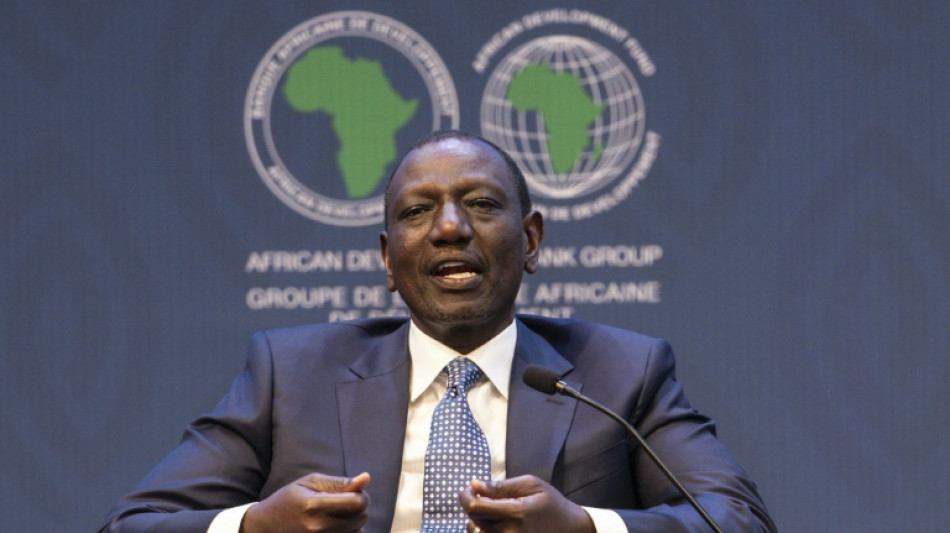
Africa presses for reform of 'unjust' global financial system / Photo: SIMON MAINA - AFP

 India seeks threefold increase in coal stocks to prevent summer power shortages

 Indus Towers expands solar-powered network to 50,000 telecom sites

 Equitas Small Finance Bank rebounds after naming interim chief executive

 Titan quarterly profit seen rising as jewellery business drives growth

 Kuwait finance minister holds economic cooperation talks at COMCEC

 Kuwait marks key events and anniversaries from national history

 Qatar media bodies discuss support for humanitarian initiatives

There is an urgent need for reforms to the "unjust" global financial system, which penalises African nations with high borrowing rates, leaders said at a major African economic gathering in Kenya this week.
Such calls have been mounting as African countries battle sometimes crippling levels of debt to fund their development as well as frequently unstable exchange rates.
The African Development Bank (AfDB) is forecasting that the continent's overall economy would expand by 3.7 percent this year, a creditable performance given the global situation but insufficient given population growth.
To "transform Africa" -- the theme of this year's AfDB annual meetings in Nairobi -- governments across the continent need vast financial resources, Kenyan President William Ruto said at an official ceremony on Wednesday.
"However, we face the rigid barrier of a global financial architecture that is fundamentally misaligned with our aspirations," he said.
Ruto complained that African countries are forced to borrow on capital markets at rates far above those paid by the rest of the world, "often up to eight to 10 times more", because of this "unjust" system.
After several years of restricted access to international markets, regional economic powerhouse Kenya was able in February to raise $1.5 billion in a new Eurobond at around 10 percent interest.
In contrast, the yield on 10-year French government bonds is currently around three percent.
AfDB president Akinwumi Adesina of Nigeria also criticised the "so-called Africa risk premium" which meant countries on the continent were forced to borrow funds at higher rates than other nations with similar credit ratings.
He told a press conference on Monday that according to the UN Development Programme, "If Africa's risks are properly and fairly estimated... African countries will save $75 billion a year just in debt service."
The Nigerian economist also said Wednesday that Africa's real gross domestic product growth was estimated at 3.7 percent this year and 4.3 percent in 2025, after an increase of 3.1 percent last year, despite many "headwinds".
But Ruto, who has been leading African calls for changes to the global financial system, warned that "the pace of African development remains far behind its undeniable potential".
A.Leibowitz--CPN
