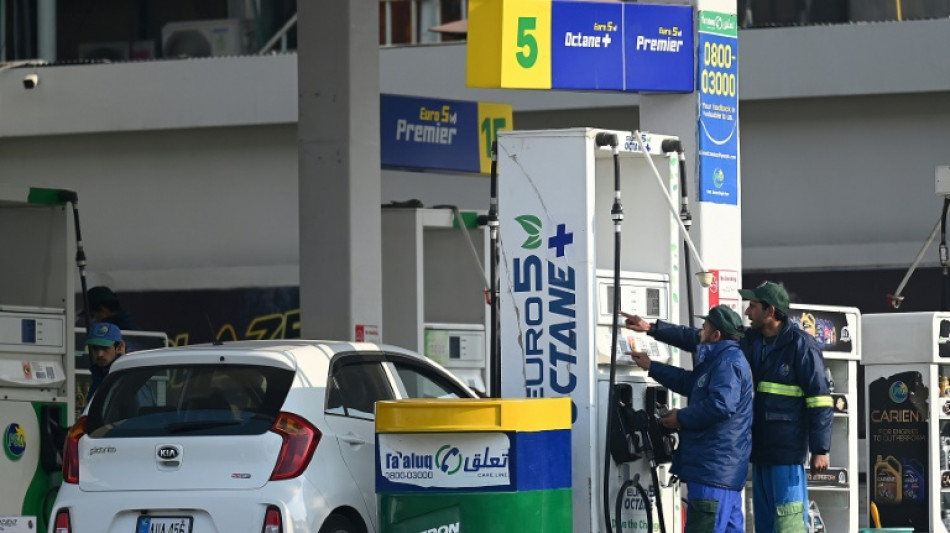
New Pakistan government says willing to curb fuel subsidies / Photo: Aamir QURESHI - AFP/File

 Billionaire Ambani's Jio soars in market debut after India's biggest IPO

 AI chip giant SK hynix posts seven-fold surge in quarterly operating profit

 S.African activists push back on data centre rush

 Billionaire Ambani's Jio to debut after record India IPO

 UK set for cautious budget as borrowing costs climb

 US Fed expected to hold rates steady ahead of key midterm elections

 AI chip giant SK hynix says quarterly operating profit soars 630%

 Charles tackles thorny legacy of slavery on Caribbean trip

 UN nuclear watchdog chief urges Iran to grant access

 Boeing releases cautious growth plan as shares fall sharply

 Tech firms gain on Anthropic IPO optimism; HSBC slumps in London

Pakistan's new finance minister on Friday agreed with IMF recommendations to reduce fuel subsidies, pledging to pursue structural reforms to boost a crisis-wracked economy.
The International Monetary Fund in 2019 approved a $6 billion loan over three years for Pakistan but disbursement has been slowed down by concerns on the pace of reforms.
Finance Minister Miftah Ismail, who took office this month after a previous government lost a no-confidence vote, said he had "good discussions" with the IMF on a visit during the Washington-based lender's annual spring meetings.
"They've talked about removing the subsidy on fuel. I agree with them," Ismail, himself a former International Monetary Fund economist, said at the Atlantic Council.
"We can't afford to do the subsidies that we're doing. So we're going to have to curtail this," he said.
He said that former prime minister Imran Khan set a "trap" for his successors through heavy subsidies on fuel.
Ismail, however, said that some targeted subsidies should remain for Pakistan's poorest amid sky-high global prices.
Pakistan's new Prime Minister Shehbaz Sharif has vowed to jumpstart a moribund economy, certain to be a major issue in elections due by late next year.
Pakistan has repeatedly sought international support and suffers from a chronically weak tax base.
Ismail said that Pakistan, the world's fifth most populous nation, needed to move to a new economic model by removing obstacles and promoting exports to the world.
"We have such an elite-benefitting country that almost every subsidy that you can speak of actually goes to the richest people," he said.
T.Morelli--CPN
