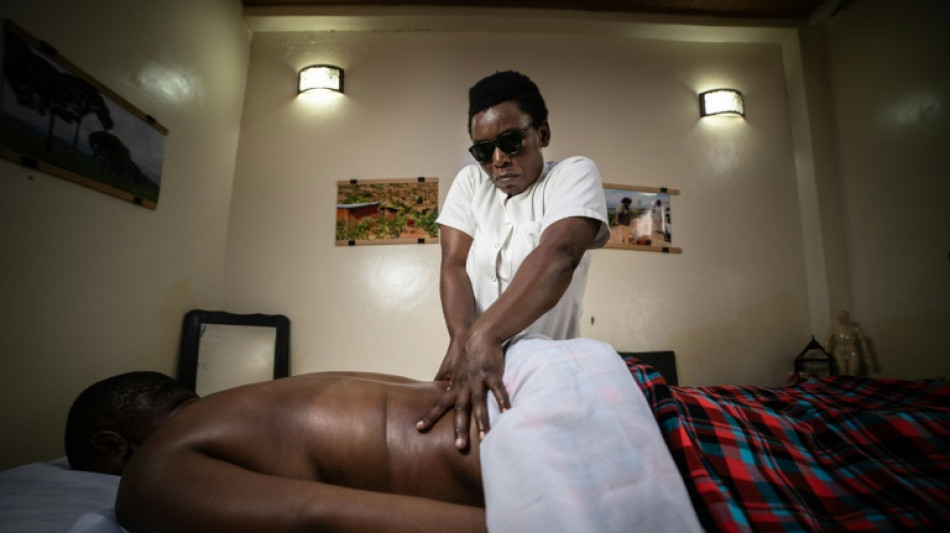
Blind Rwandans take up massage to fight stigma / Photo: Simon Wohlfahrt - AFP

 Billionaire Ambani's Jio soars in market debut after India's biggest IPO

 AI chip giant SK hynix posts seven-fold surge in quarterly operating profit

 S.African activists push back on data centre rush

 Billionaire Ambani's Jio to debut after record India IPO

 UK set for cautious budget as borrowing costs climb

 US Fed expected to hold rates steady ahead of key midterm elections

 AI chip giant SK hynix says quarterly operating profit soars 630%

 Charles tackles thorny legacy of slavery on Caribbean trip

 UN nuclear watchdog chief urges Iran to grant access

 Boeing releases cautious growth plan as shares fall sharply
 Tech firms gain on Anthropic IPO optimism; HSBC slumps in London
On a chilly morning, Beth Gatonye loaded two vibrating chairs into her van and headed to the US embassy in Kigali with three blind colleagues, ready to offer massage therapy.
Since 2017, the 43-year-old has trained dozens of visually impaired women -- and some men -- in the art of massage, with a view to creating jobs for a community that faces deep discrimination in Rwanda.
Even today, demand for the massage services offered by her company Seeing Hands is limited to foreigners, she said.
"Rwandans say that they don't want their bodies to be touched by a blind person, that it can be a sign of bad luck," she told AFP.
"It is as if Rwandans think that being blind is contagious."
The stigma is widespread across the East African nation, with visually impaired citizens struggling to access educational or professional opportunities, according to the Rwanda Union of the Blind (RUB).
"They live in isolation and solitude. Some are... hidden from the public by their families because they represent shame," RUB spokeswoman Rachel Musabyimana told AFP.
Blind Rwandans were unable to attend secondary school until the 1990s, when the curriculum was converted to braille.
They faced an even longer wait to access university education, which only became available in 2008.
"Rwandans consider us to be useless people," said Immaculee Karuhura, a visually impaired massage therapist who works with Seeing Hands.
"They think we only survive through begging," Karuhura told AFP.
- Sense of purpose -
Although the coronavirus pandemic hit their business hard, with massage services banned during Rwanda's lockdown, these days Gatonye can't keep up with demand.
"I have 15 blind women so far working as massage therapists... Getting back everyone who worked here before the Covid pandemic is difficult but we are trying," she said.
Visually-impaired people comprise more than one percent of the country's 13 million population, according to Rwanda's 2021 National Blindness Survey.
The major causes of their condition are untreated cataract and glaucoma -- up to 80 percent of cases are deemed preventable or reversible.
Businesses like Seeing Hands hold out the promise of financial freedom to blind Rwandans.
On average, the masseurs earn the equivalent of about $100 (92 euros) a month -- more than double the salaries of workers such as waitresses or housemaids
"Now I can take care of my life. I can pay rent and also pay for my children's school fees," Karuhura said.
But the job means much more than that to her, she added.
"When I am serving a client, I feel happy," she said, pointing out how the work had given her a sense of purpose and belonging.
"It feels like I am communicating with my clients during a therapy session, and this is something that makes me very emotional."
P.Gonzales--CPN
