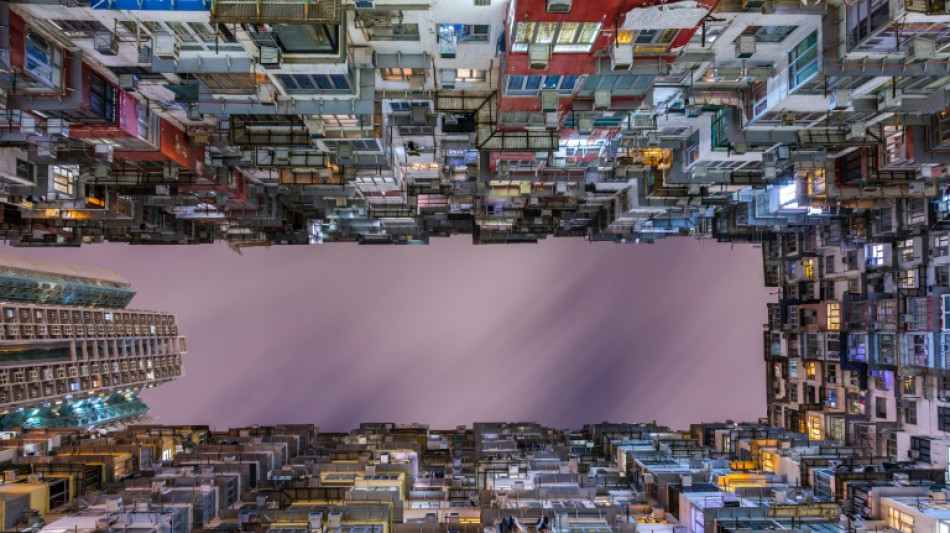
Soaring towers shape Hong Kong's urban landscape / Photo: Dale DE LA REY - AFP

 India seeks threefold increase in coal stocks to prevent summer power shortages

 Indus Towers expands solar-powered network to 50,000 telecom sites

 Equitas Small Finance Bank rebounds after naming interim chief executive

 Titan quarterly profit seen rising as jewellery business drives growth

 Kuwait finance minister holds economic cooperation talks at COMCEC

 Kuwait marks key events and anniversaries from national history
 Qatar media bodies discuss support for humanitarian initiatives

Home to some of the world's densest living districts and tallest skyscrapers, Hong Kong has for decades mesmerised locals and visitors alike with its famed skyline.
The Chinese finance hub has more than 550 buildings that are at least 150 metres (492 feet) tall and is the "number one tallest city" in the world, according to the Council on Tall Buildings and Urban Habitat skyscraper database.
Hong Kong saw a construction boom in the latter half of the 20th century as its population skyrocketed, and development kept pace after the former British colony was handed over to China in 1997.
The city's two tallest buildings, the International Commerce Centre (484 metres) and the Two International Financial Centre (412 metres), stand gleaming on opposing sides of the Victoria Harbour and cast shadows on the rushing traffic below.
Meanwhile, many of the city's 7.5 million residents live in cramped flats, with households having a median per capita floor area of around 16 square metres in 2021.
A cluster of residential blocks nicknamed "Monster Building" in Quarry Bay was catapulted to international fame after it was featured in the 2014 blockbuster "Transformers: Age of Extinction".
Older public housing complexes, such as Ping Shek Estate and Lai Tak Tsuen, have well-like central courtyards whose dramatic visual signature has made them popular with photographers.
Constrained by natural geography and a restrictive land policy, Hong Kong's urban development in decades to come has nowhere to go but up, scholars say.
S.F.Lacroix--CPN