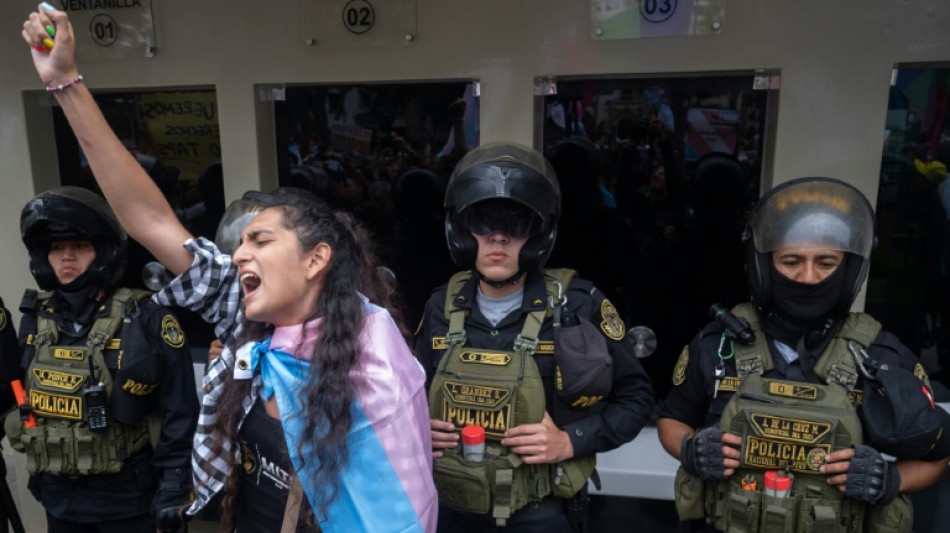
Protest after Peru classifies transsexuality as mental disorder / Photo: Cris BOURONCLE - AFP

 India seeks threefold increase in coal stocks to prevent summer power shortages

 Indus Towers expands solar-powered network to 50,000 telecom sites

 Equitas Small Finance Bank rebounds after naming interim chief executive

 Titan quarterly profit seen rising as jewellery business drives growth

 Kuwait finance minister holds economic cooperation talks at COMCEC

 Kuwait marks key events and anniversaries from national history

 Qatar media bodies discuss support for humanitarian initiatives

LGBTQ groups protested Friday outside Peru's health ministry after the government issued a decree listing transsexualism as a mental disorder.
"It is a decree that takes us back three decades," said Jorge Apolaya, spokesman of the Collective Pride March, a Lima-based rights group.
"We cannot live in a country where we are considered sick," he said.
Transgender people are those who reject the sex they were assigned at birth. Some opt for surgical or medical intervention.
The government on May 10 updated its list of insurable health conditions -- which since 2021 has offered benefits for mental health treatment -- to include services for transgender people.
In the decree, the health ministry describes the condition as a "mental disorder" -- an obsolete term long officially abandoned by the World Health Organization.
More than 200 activists gathered outside the health ministry to demand the revocation of the decree on Friday -- the International Day Against Homophobia, Biphobia and Transphobia.
"It is a regulation that violates us ... they are positioning us as sick people, as if we have a problem," said 25-year-old Afrika Nakamura.
With slogans like "It's not a disease, it's diversity!" and "We are trans and we are not sick," the protesters blocked the busy avenue in front of the ministry for a few hours.
No clashes with police were reported.
"We demand the repeal of this transphobic and violent decree, which goes against our trans identities in Peru," activist Gianna Camacho of the Coordinacion Nacional LGTBIQ+ told AFP.
"We are not mentally ill and we do not suffer from any mental disorder," she added.
The government said it would not scrap the decree.
Health ministry official Carlos Alvadrado told AFP that doing so would "remove the right to care."
The ministry has previously insisted it does not consider gender diversity as an illness, and in a statement expressed "our respect for gender identities and our rejection of the stigmatization of sexual diversity."
It said the decree was meant merely to extend mental health coverage "for the full exercise of the right to health and well-being" of those who want or need it.
An article on the website of Human Rights Watch describes the decree as "profoundly regressive" in a country that does not allow same-sex marriage nor for transgender people to change their identity documents.
For Percy Mayta, a medical doctor and activist, "pathologizing" transgender people "opens the door to... conversion therapy" -- which UN bodies have equated to torture and is not illegal in Peru.
In its press statement, Peru's health ministry underlined that "the sexual orientation and gender identity of a person does not in itself constitute a physical or mental health disorder and therefore should not be subjected to medical treatment or care or so-called reconversion therapies."
H.Müller--CPN
