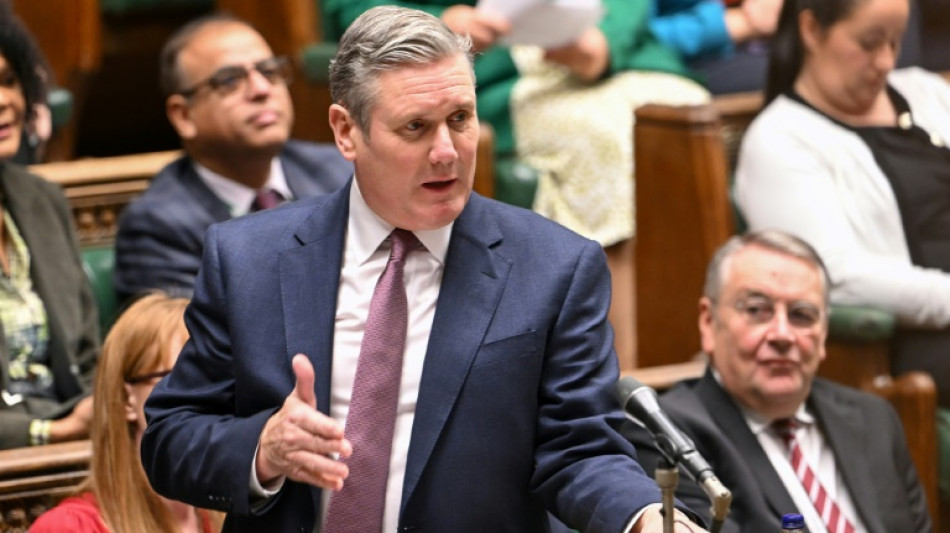
UK's Labour vows to ditch government's Rwanda deportation plan / Photo: Maria UNGER - UK PARLIAMENT/AFP

 India seeks threefold increase in coal stocks to prevent summer power shortages

 Indus Towers expands solar-powered network to 50,000 telecom sites

 Equitas Small Finance Bank rebounds after naming interim chief executive

 Titan quarterly profit seen rising as jewellery business drives growth

 Kuwait finance minister holds economic cooperation talks at COMCEC

 Kuwait marks key events and anniversaries from national history

 Qatar media bodies discuss support for humanitarian initiatives

Britain's main opposition Labour party on Friday pledged to scrap the Conservative government's flagship Rwanda scheme if it comes to power, replacing it with a tougher more joined-up approach to tackling irregular migration.
Prime Minister Rishi Sunak has staked his political reputation on his plan to "stop the boats", pushing the controversial deportation plan despite opposition from rights groups and judicial rulings.
Labour, which is widely expected to win the next general election later this year after 14 years in opposition, has been under mounting pressure to say what it will do if it is voted into office.
Immigration has become an increasingly central political issue since the United Kingdom left the European Union in 2020, largely on a promise to "take back control" of the country's borders.
Natalie Elphicke, the Conservative MP for Dover, where most of the small boats are brought ashore, this week defected to Labour, saying the government's policy was not working.
In a speech in the town, Labour leader Keir Starmer called Sunak's "stop the boats" policy an ineffective "gimmick" that was neither a deterrent nor value for money.
More than 8,800 people have crossed the Channel from northern France already this year, while a backlog in asylum claims has left about 52,000 stuck in government temporary accommodation, he said.
The Rwanda deportation scheme, which Sunak hopes to start in July, fails to tackle the issue, Starmer said.
"Only a few hundred people removed, less than one percent who cross the sea in small boats every year... for £600 million," he said, calling it "gesture politics" to satisfy anti-immigration right-wingers.
"We will replace the Rwanda policy permanently," he said, promising a new approach to securing UK borders by tackling the issue "upstream" to smash the people-smuggling gangs behind the crossings.
- 'Elite' new force -
Central to the policy will be a new "elite" Border Security Command, comprising immigration and law enforcement specialists, as well as the domestic intelligence service MI5, he added.
Money ring-fenced for the Rwanda scheme will be ploughed back into the new force.
Starmer, who oversaw several high-profile terrorism and drug-smuggling cases during his time as chief prosecutor in England and Wales, said people-smugglers were "no better than terrorists".
Tougher, pre-emptive powers to deal with them, based on counter-terrorism laws, were needed, he argued, as well as closer cooperation with the UK's European neighbours, including on joint investigations and operations.
In a message to the gangs, he said: "These shores will become hostile territory for you... We will find you, we will stop you and we will protect your victims... we will secure Britain's borders."
With Brexit, the UK lost its ability to return asylum seekers to EU member states.
Asked if Labour would look to rejoin the scheme, Starmer conceded that the Dublin agreement needed to be replaced "in some shape or form so there can be returns".
But he added that "that does not mean joining the EU scheme", as it was still possible to return asylum seekers to their country of origin.
D.Goldberg--CPN

