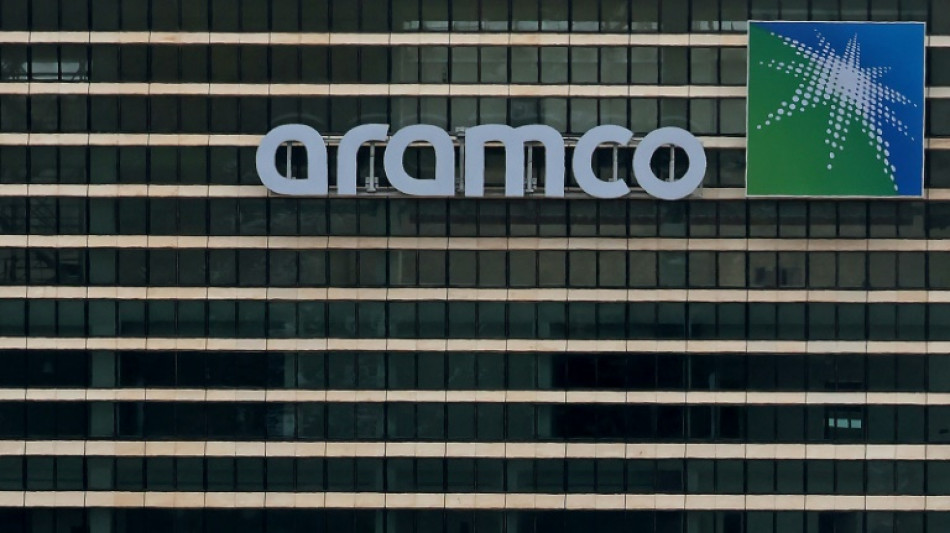
Saudi Aramco says Q1 profit down 14.5 percent / Photo: Fayez Nureldine - AFP

 India seeks threefold increase in coal stocks to prevent summer power shortages

 Indus Towers expands solar-powered network to 50,000 telecom sites

 Equitas Small Finance Bank rebounds after naming interim chief executive

 Titan quarterly profit seen rising as jewellery business drives growth

 Kuwait finance minister holds economic cooperation talks at COMCEC

 Kuwait marks key events and anniversaries from national history

 Qatar media bodies discuss support for humanitarian initiatives

Oil giant Saudi Aramco said Tuesday its first-quarter net profit dipped 14.5 percent on year to $27.27 billion as the Gulf kingdom kept production cuts in place.
Net income was 102.27 billion riyals ($27.27 billion), down from 119.54 billion riyals ($31.88 billion) for the same period in 2023, Aramco said, adding that "the decrease was primarily a result of lower crude oil volume sold".
The world's biggest crude exporter, whose profits dropped by a quarter last year, is currently producing roughly nine million barrels per day (bpd), well below its capacity of 12 million bpd.
That follows a series of production cuts dating back to October 2022, when the OPEC+ bloc of oil producers that Riyadh co-leads with Moscow announced it would reduce output by two million bpd to boost prices.
On top of that cut, in April 2023 Saudi Arabia and several other OPEC+ members agreed to slash production voluntarily by more than one million bpd.
And after an OPEC+ meeting in June 2023, Riyadh announced another reduction of one million bpd.
In March, the energy ministry said the latest cut, which took effect in July 2023, would be extended through the second quarter of this year, after which "these additional cut volumes will be returned gradually, subject to market conditions".
Aramco is the jewel of the Saudi economy, and de facto ruler Crown Prince Mohammed bin Salman is depending on oil revenue to finance an ambitious economic and social reform programme known as Vision 2030 that is intended to position his country for a prosperous post-oil future.
Aramco sold 1.7 percent of its shares on the Saudi stock market in December 2019, generating $29.4 billion in the world's biggest initial public offering.
Saudi Arabia announced in March it was transferring an additional eight percent of Aramco's shares to the sovereign wealth fund, the Public Investment Fund, which with its subsidiaries now controls 16 percent of the firm.
- Deficits expected -
The IMF said in April that, at current production levels, Saudi Arabia's fiscal break-even oil price would be $96.2 per barrel in 2024. The US Energy Information Administration currently projects Brent crude to average $89 per barrel.
The Saudi finance ministry said in December it was projecting budget deficits through 2026 as it maintains high spending on reform initiatives.
Saudi Arabia's gross domestic product decreased by 1.8 percent on year in the first quarter of 2024 compared with 2023, the General Authority for Statistics said in a preliminary estimate published last week.
"This decrease was primarily driven by a 10.6 percent decline in oil activities," it said.
Saudi Arabia has pledged to achieve net zero carbon emissions by 2060, a statement that has drawn intense scepticism from environmental activists.
Aramco has vowed to achieve "operational net-zero" carbon emissions by 2050, which does not include the emissions from customers burning its products.
In January, Aramco made the surprising announcement that the energy ministry had ordered it to maintain production capacity at 12 million barrels per day, abandoning a target of 13 million bpd by 2027.
Officials did not explain the decision at the time, but Energy Minister Prince Abdulaziz bin Salman, Prince Mohammed's half-brother, later told an energy conference it was spurred by the fact that "we're transitioning".
P.Schmidt--CPN

