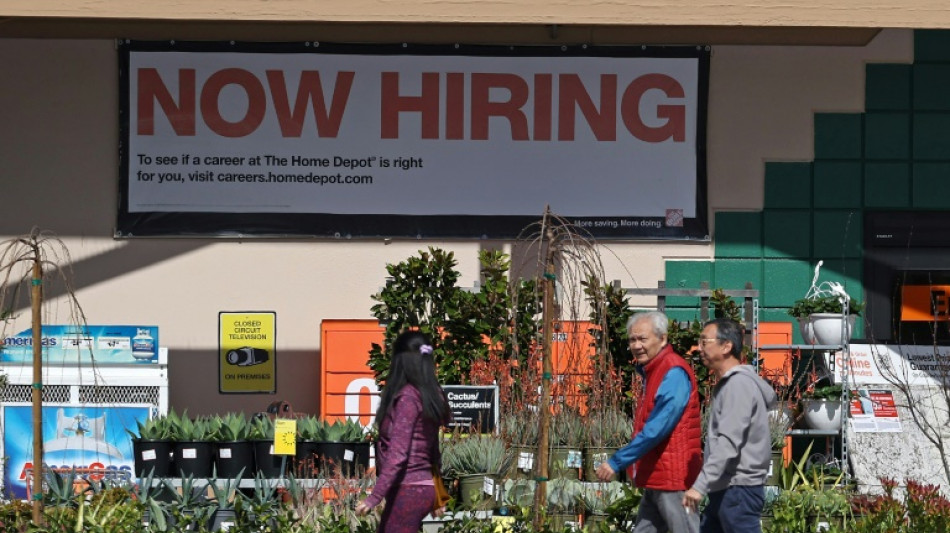
US hiring slows more than expected in sign of cooler market / Photo: JUSTIN SULLIVAN - GETTY IMAGES NORTH AMERICA/AFP/File

 India seeks threefold increase in coal stocks to prevent summer power shortages

 Indus Towers expands solar-powered network to 50,000 telecom sites

 Equitas Small Finance Bank rebounds after naming interim chief executive

 Titan quarterly profit seen rising as jewellery business drives growth

 Kuwait finance minister holds economic cooperation talks at COMCEC

 Kuwait marks key events and anniversaries from national history

 Qatar media bodies discuss support for humanitarian initiatives

US job growth came in markedly below analyst expectations in April while unemployment crept up, government data showed Friday, signaling that the labor market is cooling.
But with the world's biggest economy adding 175,000 jobs last month, hiring appears still resilient despite the lower reading than 315,000 in March, said the Department of Labor.
Analysts had expected growth of 250,000 jobs, according to Briefing.com.
The unemployment rate edged slightly higher from 3.8 percent in March to 3.9 percent last month.
While hiring has decelerated, the number of jobs added in April remains well above 100,000 –- the average level that some economists say is needed to keep the unemployment rate steady.
For now, the latest figures could prove encouraging for policymakers looking to cool the economy gradually.
Apart from an easing in hiring figures, officials are also looking to a slowdown in pay gains as they seek to bring inflation lower over the long run.
In April, wage growth came in at 0.2 percent -- from 0.3 percent in March –- on a monthly basis, according to the Labor Department.
From a year ago, average hourly earnings were 3.9 percent higher in April -- slipping below 4.0 percent for the first time since 2021.
- Rising pressure -
A solid labor market has helped to prop up consumption and economic growth despite higher interest rates, which typically makes borrowing more expensive for households and businesses.
The situation has allowed Federal Reserve Chair Jerome Powell to push back this week against talk of stagflation -– a scenario involving slow growth, high unemployment and elevated inflation.
At a press briefing on Wednesday, he told reporters: "I don't see the 'stag,' or the 'flation'."
But he has maintained that the central bank is ready to respond to an unexpected weakening in the jobs market.
For now, the US central bank has maintained the benchmark lending rate at a 23-year high, most recently citing a lack of further progress in lowering inflation in doing so.
Current readings "support the view that rates cuts –- and not hikes –- are the base case scenario for the Fed this year," said economist Rubeela Farooqi of High Frequency Economics in a note.
"The underlying economic story here, we think, is that businesses -- especially small, bank-dependent firms -- finally are feeling the pressure from sustained high real interest rates," added Pantheon Macroeconomics in a recent report.
This comes as cash accumulated during the pandemic have been drawn down, and "rolled-over floating rate debt has become much more expensive," Pantheon said.
M.García--CPN

