Milei's liberalization reforms get provisional green light / Photo: LUIS ROBAYO - AFP

 India seeks threefold increase in coal stocks to prevent summer power shortages

 Indus Towers expands solar-powered network to 50,000 telecom sites

 Equitas Small Finance Bank rebounds after naming interim chief executive

 Titan quarterly profit seen rising as jewellery business drives growth

 Kuwait finance minister holds economic cooperation talks at COMCEC

 Kuwait marks key events and anniversaries from national history

 Qatar media bodies discuss support for humanitarian initiatives

Argentina's lower house of parliament on Tuesday approved a swath of liberalizing reforms eyed by President Javier Milei, in the first legislative boost to his budget-slashing agenda.
After a marathon session that went right through Monday night, the chamber of deputies approved what remains of Milei's flagship "omnibus" reform bill with 142 votes against 106.
There were five abstentions.
The whittled-down bill includes some 230 articles -- down from the initial 600-plus rejected by lawmakers who sent the government back to the drawing board in February.
The measures include declaring a one-year state of economic emergency in Argentina, allowing Milei to disband state agencies, and privatizing about a dozen public companies including state-owned carrier Aerolineas Argentina.
Others deal with reducing access to minimum retirement allowances and weakening labor protections by allowing for longer probation periods -- slammed by the left-wing opposition as a license to fire workers.
The provisions also envision tax, customs and foreign exchange incentives to encourage investment in the economically crisis-ridden country.
"This is a fundamental first step to get Argentina out of the swamp it has been in," Milei said on X, welcoming the vote.
The bill must next go to the Senate, where the president's party is in an even smaller minority than in the lower house.
- More protests planned -
Self-declared "anarcho-capitalist" Milei won elections last November vowing to take a chainsaw to public spending and reduce the budget deficit to zero.
By decree, he has cut the cabinet in half, slashed 50,000 public jobs, suspended new public works contracts and ripped away fuel and transport subsidies, even as wage-earners lost a fifth of their purchasing power and annual inflation approached 290 percent.
The poverty level in Argentina has reached six in ten people, according to a recent study.
Last week, Milei hailed the South American country's first quarterly budget surplus since 2008 and warned struggling Argentines not to "expect a way out through public spending."
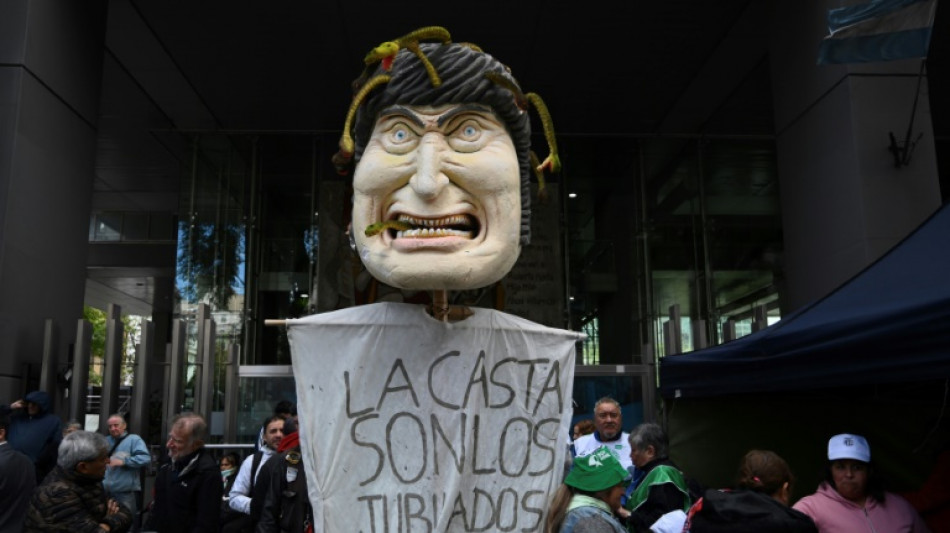
There have been many protests against Milei's plans since he took office in December, with the largest yet last week, when hundreds of thousands marched against cuts to public university funding.
Workers' unions are organizing more demonstrations on Labor Day on Wednesday, and have called a national strike for May 9.
Things have not gone Milei's way in parliament until now.
After his original "omnibus" bill got thrown out in February, the Senate rejected a so-called "mega-decree" in March that included plans to abolish rent caps and relax labor laws.
Margarita Stolbizer, a center-right lawmaker, said during the debate that the new version of Milei's "omnibus" bill was "much more reasonable."
"We recognize that there is an emergency, it would be foolish not to recognize it. We accept that the executive branch will ask us for tools to deal with this crisis," she said.
A.Leibowitz--CPN