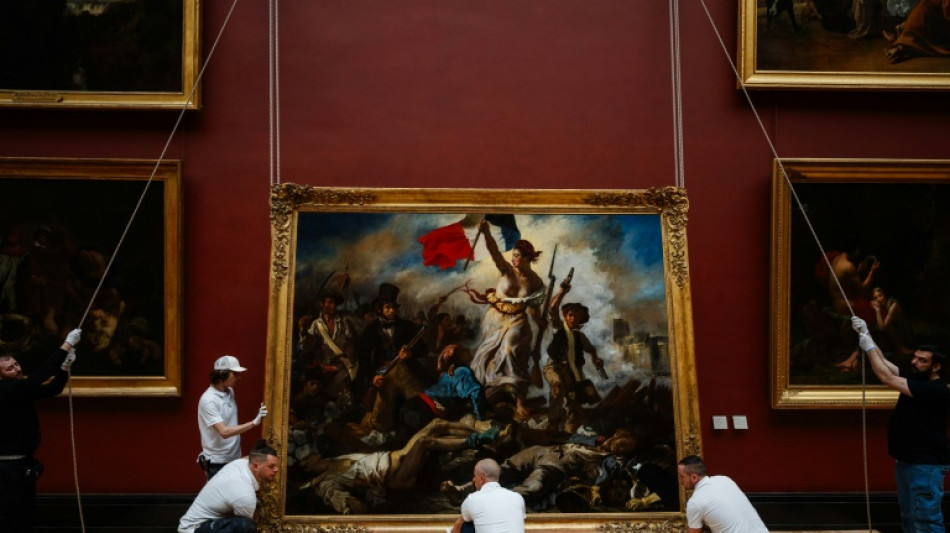
Iconic French painting to make comeback in true colours / Photo: Dimitar DILKOFF - AFP

 India seeks threefold increase in coal stocks to prevent summer power shortages

 Indus Towers expands solar-powered network to 50,000 telecom sites

 Equitas Small Finance Bank rebounds after naming interim chief executive

 Titan quarterly profit seen rising as jewellery business drives growth

 Kuwait finance minister holds economic cooperation talks at COMCEC

 Kuwait marks key events and anniversaries from national history

 Qatar media bodies discuss support for humanitarian initiatives

A world-famous painting of a bare-chested woman leading French revolutionaries is this week to reveal its true colours after restorers cleansed it from decades of varnish and grime.
The public will be able to admire Eugene Delacroix's "Liberty Leading the People" in its full glory at the Louvre museum from Thursday.
"We're the first generation to rediscover the colour" of the work, said an enthusiastic Sebastien Allard, director of paintings at the Paris museum.
Delacroix painted the artwork to commemorate France's July Revolution of 1830.
He depicted a woman personifying Liberty brandishing the French flag and leading armed men over the bodies of the fallen.
The image has since become iconic, in the 20th century even appearing on French banknotes.
The French state bought the painting in 1831 during its first public exhibition, and it has been housed at the Louvre since 1874.
A national treasure, it has only ever travelled outside France once -- to Japan in 1999.
Over the years restorers had applied eight layers of varnish in a bid to brighten its colours, but instead ended up drowning them under a coating of drab yellow.
The colours, "the whites, the shadows -- all of this ended up melting together under these yellowish layers," Allard said.
"Grime and dust" had also become trapped in the varnish.
- 'Enchanting' -
After six months of painstaking restoration -- the painting's first since 1949 -- a bright blue sky has re-emerged above the Notre-Dame cathedral in the work's background.
White smoke bursts from the men's guns and dust more clearly clings to the air above the Paris barricade.
Benedicte Tremolieres, one of the two restorers to clean the canvas, said it was "enchanting" to see the painting reveal its secrets.
Her colleague Laurence Mugniot agreed.
"Delacroix hid tiny dabs of blue, white and red all over in a subtle sprinkling to echo the flag," she said.
She pointed for example to the "blue eye with a speck of red" of one of the characters.
Because of its size -- 2.6 by 3.25 meters -- all restoration work had to be done on site.
Curator Come Fabre said specialists first thoroughly inspected the artwork using X-ray, ultraviolet and infrared radiation, comparing what they found with archive images of the painting.
The restorers then carried out tests on tiny fractions of the work.
Peering through a magnifying glass or microscope, "they even discovered that certain alterations, including a brown mark on Liberty's dress, had been added after Delacroix and could therefore be removed," Fabre said.
The curator said it was no wonder the painting had become such a symbol.
After the end of France's German occupation during World War II, it appeared on banknotes and stamps, he said.
In more recent years, French street artist Pascal Boyart depicted Liberty leading a group of "yellow vest" protesters.
And adaptations of the painting have also appeared at protests in Bulgaria and Hong Kong.
"Delacroix's brilliant idea is to have managed to represent unstoppable collective action in movement, with men rallying around a woman embodying the idea of liberty," Fabre said.
P.Gonzales--CPN


