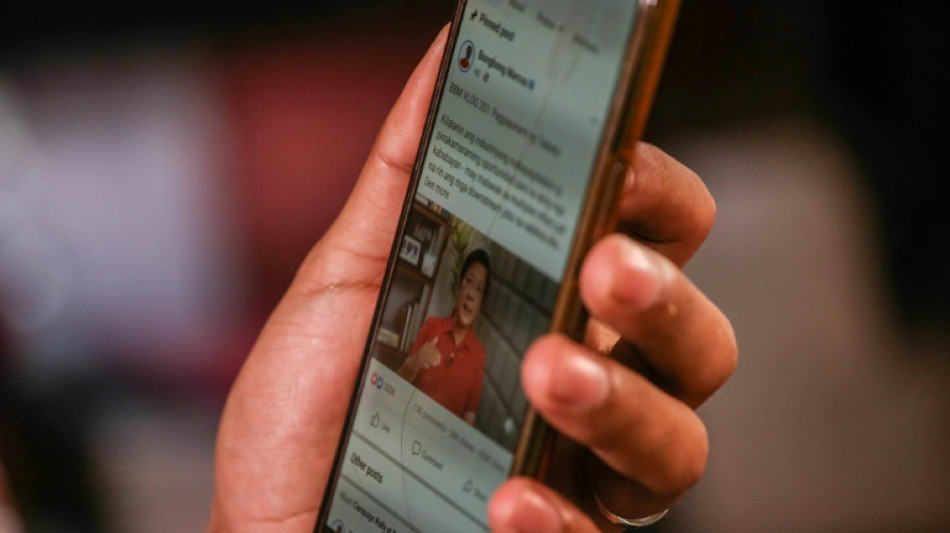
Philippines' Duterte blocks bill to register social media users / Photo: Jam STA ROSA - AFP

 Billionaire Ambani's Jio soars in market debut after India's biggest IPO

 AI chip giant SK hynix posts seven-fold surge in quarterly operating profit

 S.African activists push back on data centre rush

 Billionaire Ambani's Jio to debut after record India IPO

 UK set for cautious budget as borrowing costs climb

 US Fed expected to hold rates steady ahead of key midterm elections

 AI chip giant SK hynix says quarterly operating profit soars 630%

 Charles tackles thorny legacy of slavery on Caribbean trip

 UN nuclear watchdog chief urges Iran to grant access

 Boeing releases cautious growth plan as shares fall sharply
 Tech firms gain on Anthropic IPO optimism; HSBC slumps in London
Philippine President Rodrigo Duterte has rejected a proposed law requiring social media users to register their real names and phone numbers, citing threats to free speech and privacy, his spokesman said Friday.
The legislation, designed to combat fake news, online abuse, text scams and militant bombings, also required mobile phone users to provide their personal details when buying SIM cards.
It was approved by both houses of Congress in February, but critics said it was a form of state surveillance.
While supporting efforts to tackle cybercrime and other online offences, Duterte said he opposed the inclusion of social media user registration in the bill.
He called for "a more thorough study" of the provision, citing concerns it could lead to "dangerous state intrusion and surveillance threatening many constitutionally protected rights" such as individual privacy and free speech, presidential spokesman Martin Andanar said in a statement.
Filipinos rank among the world's heaviest users of social media, and the country has become a key battleground for misleading or fake news.
Renato Reyes, secretary-general of leftist alliance Bayan, welcomed the veto, saying SIM card and social media registration created a "chilling effect" for users and would "not deter crime".
"A big part of the problem is government itself, as it benefits directly and indirectly from nefarious online activities," Reyes said in a statement.
"We should start with demanding the government stop weaponizing social media and attacking people online."
Duterte's election victory in 2016 was underpinned by social media campaigning at a time when online misinformation was on the rise.
Critics accused the Duterte camp of employing online trolls to praise him while attacking dissenters -- even issuing death threats. Duterte has denied the allegations.
Since taking power, the authoritarian firebrand has been accused of harassing or even jailing opponents and shutting down media outlets critical of his policies.
Duterte's decision to block the bill comes as a torrent of misinformation floods Facebook, YouTube, TikTok and Twitter ahead of the May 9 national elections.
Ferdinand Marcos Junior is leading the race for the presidency, while his running mate and first daughter Sara Duterte is the top contender for vice president.
Senate president and vice presidential candidate Vicente Sotto, who had supported the legislation, responded sarcastically to the veto.
"Great! Bombings and blackmail and scams will continue using prepaid sims," Sotto tweeted.
Many mobile phone users in the Philippines use pre-paid SIM cards that they buy over the counter without giving their names and addresses to providers.
Militant groups fighting the government in the country's south are known to favour the use of mobile phones to remotely detonate improvised explosive devices, leaving police with one less way to track the perpetrators.
The proposed measure can still become law if legislators can muster a two-thirds vote in each chamber to override the presidential veto, but that is unlikely to happen before the polls.
O.Hansen--CPN
