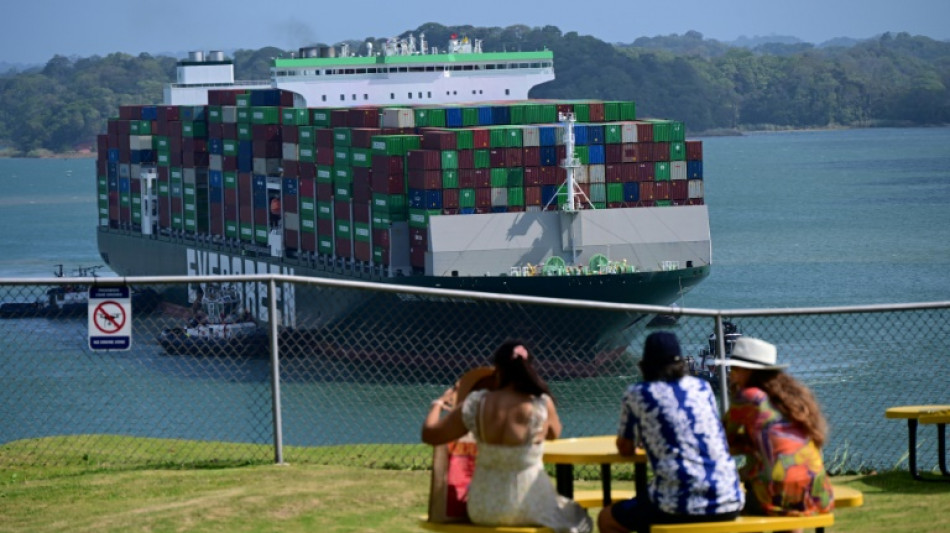
Drought-hit Panama Canal to ease traffic restrictions / Photo: MARTIN BERNETTI - AFP

 Mutual fund returns show shifting leaders across market-cap categories

 IndiGo holds talks with Embraer over potential order for 100 aircraft

 Indian companies report mixed second-quarter results on November 4

 KKR secures Indian regulator approval for Gentari Renewables investment

 Bharti Airtel revenue expected to grow at double-digit pace in second quarter

 Indian crude-sensitive shares gain after 13% oil-price decline

 Stocks and dollar fall as Democratic election gains reshape markets

 Qatar Tourism joins Pacific Asia Travel Association at London travel market

The number of ships allowed through the drought-hit Panama Canal each day will be increased thanks to signs of an improvement in water levels, authorities said Monday.
The interoceanic channel is a key transit point for international cargo, but low water levels blamed on climate change and the El Nino phenomenon last year led officials to limit the number of vessels using it.
The Panama Canal Authority said Monday that it had informed clients it would gradually allow up to 32 ships through per day, compared with a limit of 27 announced a month ago.
In 2022, it had welcomed an average of 39 ships a day.
"The management and administration of water has been very efficient," canal administrator Ricaurte Vasquez told AFP.
The arrival of the rainy season was also expected to help, he added.
Restrictions on the maximum draft (water depth) of ships passing through the largest locks will be increased in mid-June to 13.71 meters (45 feet), from 13.41, authorities said.
The century-old maritime channel, which usually handles about six percent of global maritime trade, uses rainwater stored in two artificial lakes.
The canal -- used mainly by customers from the United States, China and Japan -- has a system of locks to raise and lower ships.
For each vessel that passes through it, 200 million liters of fresh water are released into the sea.
C.Smith--CPN