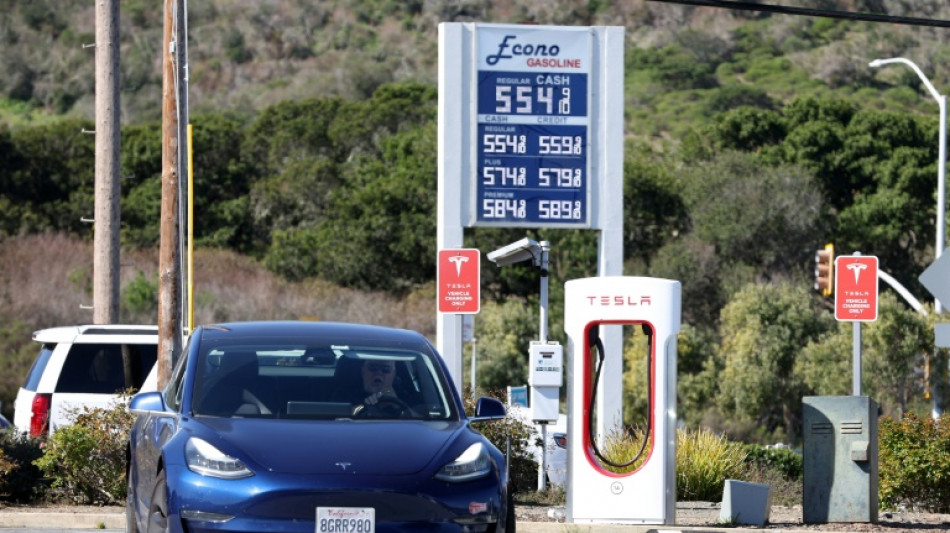
US retail sales up more than expected in March / Photo: JUSTIN SULLIVAN - GETTY IMAGES NORTH AMERICA/AFP/File

 Mutual fund returns show shifting leaders across market-cap categories

 IndiGo holds talks with Embraer over potential order for 100 aircraft

 Indian companies report mixed second-quarter results on November 4

 KKR secures Indian regulator approval for Gentari Renewables investment

 Bharti Airtel revenue expected to grow at double-digit pace in second quarter

 Indian crude-sensitive shares gain after 13% oil-price decline

 Stocks and dollar fall as Democratic election gains reshape markets

 Qatar Tourism joins Pacific Asia Travel Association at London travel market

Retail sales in the United States grew more than anticipated last month, government data showed on Monday, defying predictions of weaker consumer demand.
US retail sales picked up by 0.7 percent in March to $709.6 billion, after February's increase was revised to 0.9 percent, said the Commerce Department.
From a year ago, the March figure was 4.0 percent higher.
Boosting the headline figure was a 2.1 percent rise in gas station sales from February to March, said the latest report.
Excluding gas stations, overall sales were up by a slightly lower 0.6 percent.
But motor vehicle and parts dealers saw a sales decline of 0.7 percent in March, while electronics and appliance stores' sales slid 1.2 percent.
While resilience in consumer spending has helped US economic growth in the last year, analysts expect demand to cool this year amid cost fatigue and high interest rates.
Households would also have drawn down on savings from the Covid-19 pandemic period.
"Even as households face ongoing challenges from high borrowing costs and elevated inflation, they continue to spend," said Rubeela Farooqi, chief US economist at High Frequency Economics.
She added in a note that looking ahead, an eventual decline in the Federal Reserve's benchmark lending rate should be "positive for consumer spending" while a robust labor market should help with incomes, spending and growth.
Analysts at Pantheon Macroeconomics cautioned that retail sales numbers are "hard to forecast with much confidence" given the potential for substantial revisions.
For now, Pantheon expects consumption in the first three months this year to slow from that in the fourth quarter last year.
C.Smith--CPN