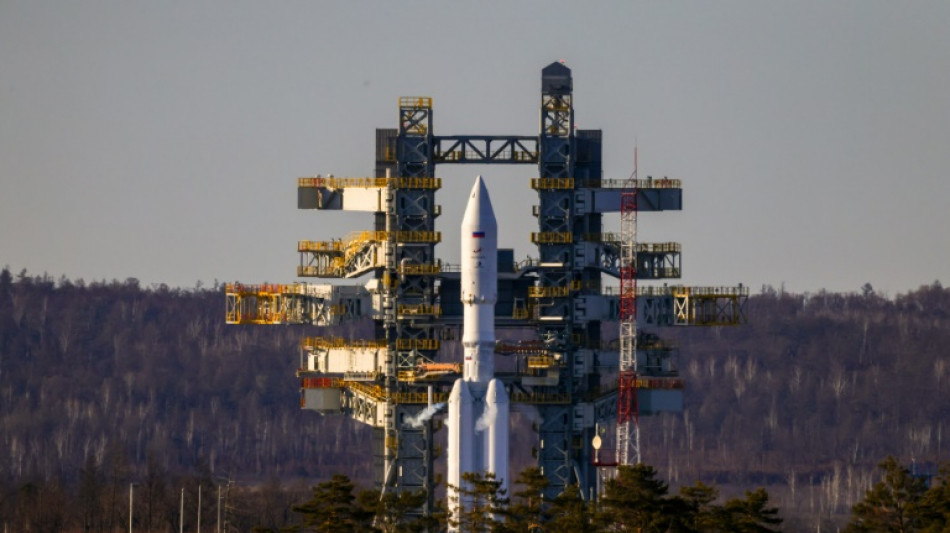
Russian rocket lifts off at third attempt / Photo: Handout - ROSCOSMOS/AFP

 Mutual fund returns show shifting leaders across market-cap categories

 IndiGo holds talks with Embraer over potential order for 100 aircraft

 Indian companies report mixed second-quarter results on November 4

 KKR secures Indian regulator approval for Gentari Renewables investment

 Bharti Airtel revenue expected to grow at double-digit pace in second quarter

 Indian crude-sensitive shares gain after 13% oil-price decline

 Stocks and dollar fall as Democratic election gains reshape markets

 Qatar Tourism joins Pacific Asia Travel Association at London travel market

A Russian rocket blasted off for a test flight on Thursday at the third try, after previous launch attempts earlier this week were aborted in the final seconds of countdown.
The flagship Angara A5 -- a powerful spacecraft designed to carry heavy payloads into low Earth orbit -- took off from the Vostochny Cosmodrome in the Russian Far East, a live broadcast showed.
"The rocket worked according to plan. The upper stage separated ... and is currently putting the test payload into target orbit," the Roscosmos space agency said in a social media post shortly after the launch.
Launch attempts on Tuesday and Wednesday were cancelled due to a failure in a pressurising system in an oxidiser tank and in the engine control system, according to Roscosmos.
A Roscosmos broadcast showed the craft had reached an altitude of 268 kilometres (167 miles) in the 13 minutes after take-off.
Russia's space programme has been hit by a number of high-profile setbacks in recent years.
Last month Russia delayed the launch of a Soyuz spacecraft to the International Space Station (ISS), again at the last minute.
On that occasion, three astronauts -- from Russia, Belarus and the United States -- were strapped in and ready for take-off when a "voltage dip" triggered an automatic shutdown seconds before blast-off.
The launch went ahead two days later.
And last year Russia's first mission to the moon in almost 50 years failed when a lander crashed into the lunar surface.
Russia's development of the Angara A-5, a heavy booster rocket designed to ferry tonnes of equipment into space, has also been beset by delays.
It has had only three previous test launches over the last 10 years, one of which was a partial failure.
Moscow plans to use its cargo capacities to deliver modules for a rival to the ISS that it hopes to construct in the coming years.
A.Zimmermann--CPN