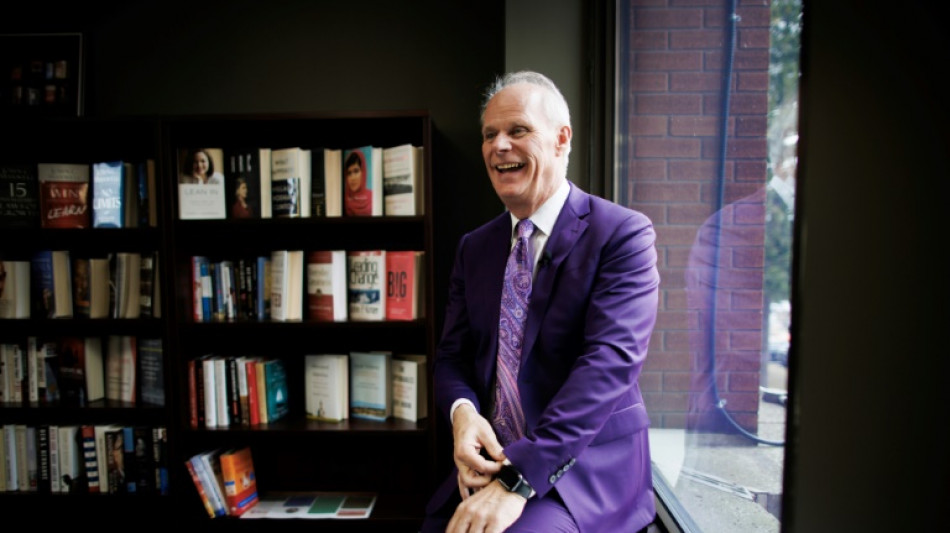
From homeless addict to city chief: the unusual journey of Canadian mayor / Photo: Cole BURSTON - AFP

 Mutual fund returns show shifting leaders across market-cap categories

 IndiGo holds talks with Embraer over potential order for 100 aircraft

 Indian companies report mixed second-quarter results on November 4

 KKR secures Indian regulator approval for Gentari Renewables investment

 Bharti Airtel revenue expected to grow at double-digit pace in second quarter

 Indian crude-sensitive shares gain after 13% oil-price decline

 Stocks and dollar fall as Democratic election gains reshape markets

 Qatar Tourism joins Pacific Asia Travel Association at London travel market

Dan Carter once was a drug addict living on the streets, but now runs a Canadian city and draws from his darkest times to tackle a housing crunch and an addiction crisis.
"I truly believe in my heart of hearts that everyone is worth saving," says the mayor of Oshawa, Ontario, admitting that in the past he himself consumed copious amounts of cocaine and alcohol.
"That's why it matters to me where we are today and the complexities of housing or homelessness, and addiction," he explains.
Carter, 64, was in 2018 elected mayor of this city of 189,000 residents near Toronto, as citizens and authorities began to take notice of soaring opioid overdoses and homelessness.
Today, Carter says, Canada has the "most serious health crisis" ever and is calling for a national state of emergency to focus on affordable housing and battling addiction.
In Oshawa alone, the number of homeless people jumped from 45 before the Covid-19 pandemic to more than 300 today -- a rise echoed across Canada.
"It's expensive (and) it's very hard to find a place you can rent around here," says Chris Harris, a homeless man whose partner died of an overdose.
Carter set up a first-of-its-kind regional reception center in Oshawa which offers meals and temporary accommodations but also medical and psychological care.
He also established a program to increase collaboration between first responders and social workers, and another aimed at collecting used syringes in parks and public spaces. Last year alone, Oshawa emergency services responded to more than 500 overdose calls.
All of these accomplishments were inspired by his own experiences.
"By the time I was 31, I was mentally, emotionally, physically, financially and spiritually broken," says the politician. "Addiction took me to every dark place you could possibly imagine."
- 'Sober up or die' -
Born in New Brunswick in eastern Canada, Carter experienced a difficult childhood marked by the death of his mother and brother, learning disabilities linked to his dyslexia and a sexual assault that he hid for a long time.
As a young adult, he spent a few days in prison for forging a check, an episode that still haunts him decades later.
"I have to travel to the United States regularly and I have to get clearance every single time... because I have a criminal record," he says.
Carter turned his life around in his early 30s thanks to his sister. "She said, 'You got two choices: you can either sober up or you can die today," he recalls.
After a detox treatment, the man whom everyone just calls Dan got back on his feet and by chance landed a job in television despite having "no formal education, no journalism degree and no skills or abilities" and "losing my hair."
His dyslexia continued to dog him, but his progress in reading and his "natural curiosity about people" allowed him to pursue a career in media for more than 20 years.
Grateful for all the help he received at that time, he in turn wants to extend his hand to those most in need.
"Dan is as frustrated as everybody else in that those solutions don't come quick enough," comments Nathan Gardner, director of the Back Door Mission shelter, who described the homeless population as facing "a lot of despair."
But Carter is not losing optimism. "We can do better than what we're doing today," he says.
H.Meyer--CPN