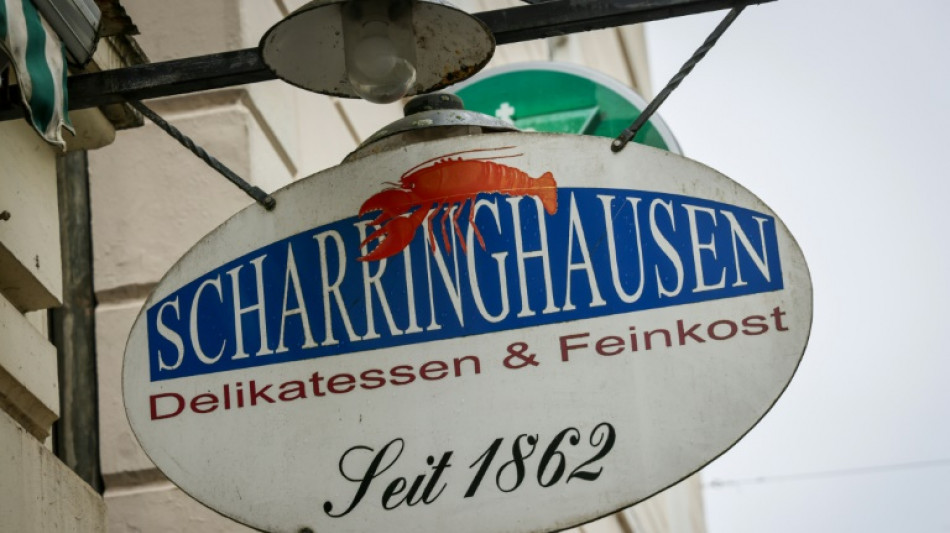
German family businesses desperately seeking buyers / Photo: FOCKE STRANGMANN - AFP

 Mutual fund returns show shifting leaders across market-cap categories

 IndiGo holds talks with Embraer over potential order for 100 aircraft

 Indian companies report mixed second-quarter results on November 4

 KKR secures Indian regulator approval for Gentari Renewables investment

 Bharti Airtel revenue expected to grow at double-digit pace in second quarter

 Indian crude-sensitive shares gain after 13% oil-price decline

 Stocks and dollar fall as Democratic election gains reshape markets

 Qatar Tourism joins Pacific Asia Travel Association at London travel market

The Scharringhausen deli has been selling fine foods and wines in northern Germany for 160 years, but its future is in doubt as it struggles to find a buyer to take over the business.
Juergen Scharringhausen, who is in his 70s, has been trying to sell the family business in Bremen on the banks of the river Weser for almost two years, but has yet to receive a serious offer.
Many owners of small and medium-sized enterprises (SMEs) in Germany are in a similar position, thanks to the double burden of an ageing population and a stagnating economy.
"Anyone with ideas and a love of food would be welcome," Scharringhausen told AFP.
"If nothing comes of it, I'll have to close down," said Scharringhausen, wearing a black apron embroidered with a champagne label, alongside his wife Simone.
The shop, founded by his great-great-grandfather, offers fine products from around the world, with two fish and deli counters, a wine cellar and a 25-seat bistro area.
Including catering services and online sales, the business generates half a million euros ($540,000) in annual sales, with four employees and occasional reinforcements.
- Buyers wanted -
According to a recent study by Commerzbank, one in three German companies with annual sales of up to 15 million euros are currently struggling to find buyers.
Up to 250,000 businesses could be forced to shut down over the next five years, said Christian Erbe, president of the local chamber of commerce in Baden-Wuerttemberg state.
There is currently an average of only one candidate for every three businesses in need of new owners, according to the national association for the German chambers of commerce (DIHK).
In the hotel and catering sector, it's one candidate for every seven businesses.
"The problem of business succession has become much worse," said Karsten Nowak, director of the Bremen chamber of commerce.
In the small German city-state, 59 out of every 1,000 businesses will be looking for a new owner between 2022 and 2026 -- the highest proportion of any of Germany's 16 states, according to IfM research institute for SMEs in Bonn.
- Family problems -
The problem is the same demographic trend that is currently leading to a shortage of skilled workers in Germany: with the baby boomer generation entering retirement, there are "not enough candidates between the ages of 18 and 40 to take over established businesses", Nowak said.
Another issue is that younger workers tend to prefer salaried jobs with "flexible working hours and a good work-life balance", according to Erbe.
Juergen Scharringhausen took over the family business in 1987, the year his daughter was born. Now a buyer in a large commercial group, she will not be taking over.
Entrepreneurial culture is still "rarely taught in schools, except from a critical angle", Nowak believes.
The volatility of the economy is also putting off potential buyers, who are reluctant to take on the long-term debt needed for an acquisition in an uncertain climate, he said.
Entrepreneurs struggling to sell their businesses blame "over-regulation, the future of the economy and energy costs" for the lack of candidates, said Detlef Schmidt-Schoele, in charge of successions at the Thuringia chamber of commerce.
The government has attempted to address the problem by launching a website to link businesses with potential new owners, overseen by the economy ministry.
There are thousands of adverts on the site from all over Germany: a car parts manufacturer in Baden-Wuerttemberg, a mechanical engineering company in Lower Saxony, a timber merchant in Thuringia.
Many of them are family-run businesses.
A survey of German family-run SMEs published by Ifo last year found that 42 percent of respondents had not yet found a family member to take over.
A.Agostinelli--CPN