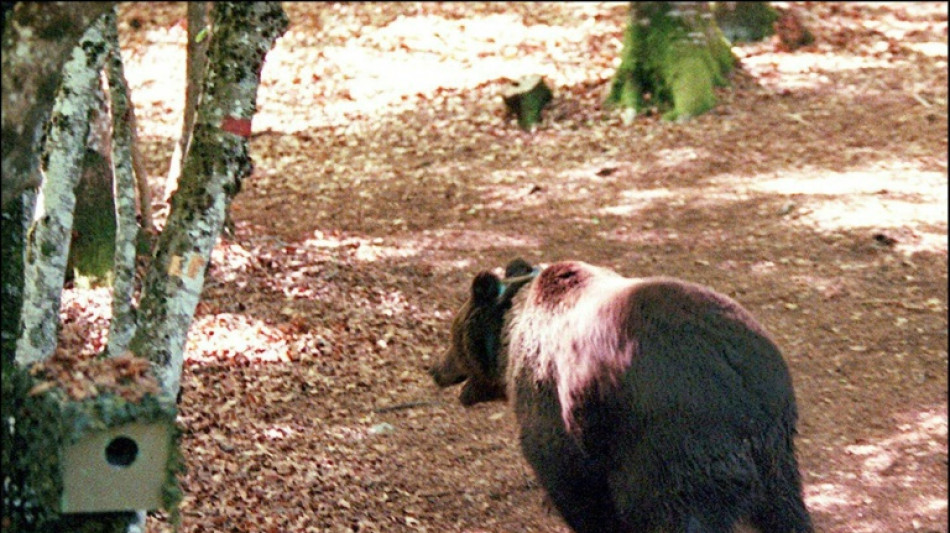
Brown bear numbers grow in Pyrenees: France / Photo: GABRIEL BOUYS - AFP

 Mutual fund returns show shifting leaders across market-cap categories

 IndiGo holds talks with Embraer over potential order for 100 aircraft

 Indian companies report mixed second-quarter results on November 4

 KKR secures Indian regulator approval for Gentari Renewables investment

 Bharti Airtel revenue expected to grow at double-digit pace in second quarter

 Indian crude-sensitive shares gain after 13% oil-price decline

 Stocks and dollar fall as Democratic election gains reshape markets

 Qatar Tourism joins Pacific Asia Travel Association at London travel market

The population of brown bears in the Pyrenees mountains, which had been threatened with extinction, keeps growing, French authorities said Tuesday.
Bears had nearly disappeared from the Pyrenees when France began a reintroduction programme in the 1990s, importing them from Slovenia.
Activists see bears as integral to preserving a fragile mountain ecosystem that is under threat from human activity and climate change.
But the presence of bears in the mountain range straddling the border of France and Spain has led to increasing tensions with farmers because of the threat they pose to their livestock.
"With a minimum of 83 individuals detected in 2023, the size of the brown bear population is gradually continuing to increase in the Pyrenees," the French Biodiversity Agency (OFB) said.
By comparison, there were 76 bears across the region in 2022.
The presence of the omnivores has also been observed in Andorra and on the Spanish side of the Pyrenees, in the regions of Catalonia, Aragon and Navarre.
The figures are based on data collected by the Brown Bear Network, which includes OFB staff and specialist associations.
The genetic analysis of hair and faeces as well as photographs and videos are used to estimate the number of bears.
The OFB report said that last year the number of bear attacks on livestock in the French Pyrenees had risen five percent from the previous year, while the number of animals killed had fallen by seven percent.
In a statement, associations from the Brown Bear Network welcomed the increase in the population, but expressed concern about "growing inbreeding" and called on the government to "bring in new blood".
More than 85 percent of bears born since 1996 are the offspring of one male, Pyros.
In 2020 and 2021, four bears were killed illegally. They have not been replaced.
H.Cho--CPN