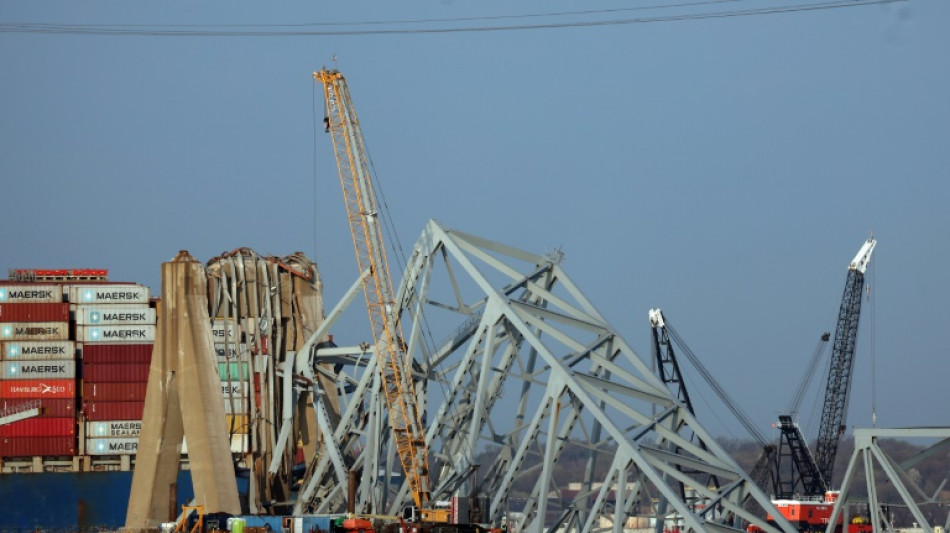
Huge crane ready to clear Baltimore bridge debris / Photo: Kevin Dietsch - GETTY IMAGES NORTH AMERICA/AFP

 Mutual fund returns show shifting leaders across market-cap categories

 IndiGo holds talks with Embraer over potential order for 100 aircraft

 Indian companies report mixed second-quarter results on November 4

 KKR secures Indian regulator approval for Gentari Renewables investment

 Bharti Airtel revenue expected to grow at double-digit pace in second quarter

 Indian crude-sensitive shares gain after 13% oil-price decline

 Stocks and dollar fall as Democratic election gains reshape markets

 Qatar Tourism joins Pacific Asia Travel Association at London travel market

The largest crane on the US Eastern Seaboard readied Friday to begin salvage work to clear Baltimore harbor after a cargo ship crashed into a major bridge causing it to collapse.
Vessel traffic through the busy Port of Baltimore has been suspended indefinitely since the accident brought down the Francis Scott Key Bridge in stunning speed, claiming the lives of six men working on a pothole repair team.
Road traffic has also been impacted, with thousands of motorists each day being diverted to an already congested tunnel under the city.
The work of clearing tons of steel debris from the deep waters of the Patapsco River is expected to be difficult and dangerous, made more delicate by the fact that the bodies of four workers have yet to be recovered.
But the arrival of the huge floating crane -- able to lift a 1,000-ton load -- will allow the work to begin.
The four missing workers are believed to have been killed when the Singapore-flagged, 1,000-foot (300-meter) container ship Dali lost power and careened into a bridge support column early Tuesday.
- Removing debris -
Officials said that as the crane begins work, with two more smaller floating cranes en route, an early challenge will be to cut the twisted bridge wreckage into pieces the cranes can handle.
The federal administration has approved $60 million in emergency funding for the complex cleanup and recovery operation, while the cost of building a new bridge could ultimately hit $1 billion.
The operation will likely take place in three phases: trusses from the bridge removed to allow one-way traffic into and out of the port; bridge segments on the ship lifted so the ship can be moved; and then steel and concrete debris from the river bed cleared.
The project will likely take months, though one analyst told the US Naval Institute that the channel could be reopened for limited traffic in as little as a month.
The Army Corps of Engineers, which is leading the effort, said it has activated an emergency plan to deploy more than 1,100 engineering, construction, contracting and operations specialists.
The Corps is also sending remotely operated vehicles and sonar equipment; several ships to help in debris removal; and dive safety experts.
- Shipping diverted -
The accident had an immediate impact on cargo shipping -- and on the jobs of an estimated 15,000 people employed directly at the major port -- with auto, coal and sugar shippers immediately affected.
Baltimore is the biggest vehicle-handling port in the country, according to US Transportation Secretary Pete Buttigieg.
Abe Eshkenazi, CEO of the Association for Supply Chain Management, told CNN that the country's supply chains were more resilient today thanks to work done after the Covid-19 pandemic caused huge shipping delays.
U.Ndiaye--CPN