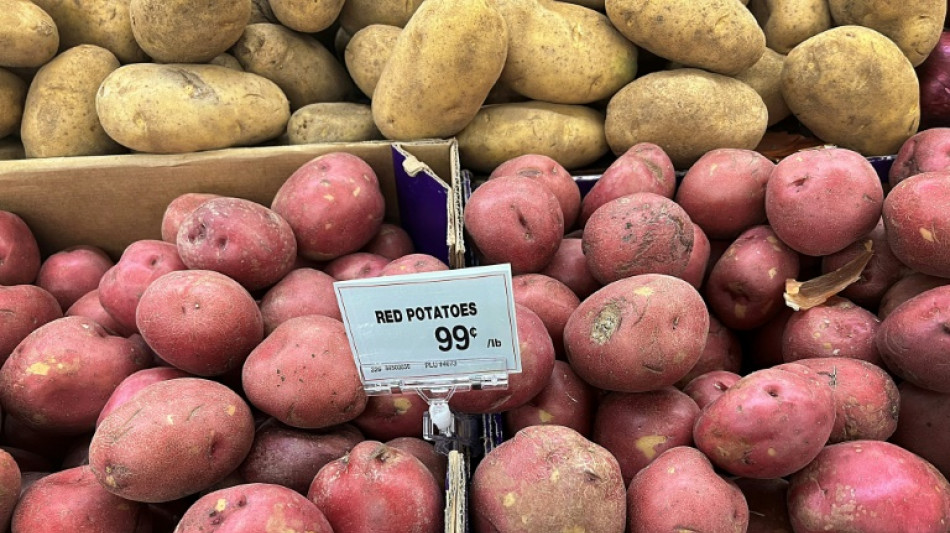
I yam what I yam: US govt roasted over potato classification / Photo: SCOTT OLSON - GETTY IMAGES NORTH AMERICA/AFP

 Mutual fund returns show shifting leaders across market-cap categories

 IndiGo holds talks with Embraer over potential order for 100 aircraft

 Indian companies report mixed second-quarter results on November 4

 KKR secures Indian regulator approval for Gentari Renewables investment

 Bharti Airtel revenue expected to grow at double-digit pace in second quarter

 Indian crude-sensitive shares gain after 13% oil-price decline

 Stocks and dollar fall as Democratic election gains reshape markets

 Qatar Tourism joins Pacific Asia Travel Association at London travel market

When is a vegetable not a vegetable? When it's a potato, according to a new US government proposal to reclassify the starchy staple that has infuriated lawmakers in rural districts.
US senators Susan Collins and Michael Bennet -- a Maine Republican and a Colorado Democrat -- are spearheading a bid to convince government officials to back away from plans to call the root vegetable a grain, a move they fear would hurt farming.
"Since the inception of the US Department of Agriculture, it has classified potatoes correctly as a vegetable," Collins and Bennet said in a letter to both the USDA and the Department of Health and Human Services.
The proposals for stripping the potato of its "vegetable" status appear in the forthcoming Dietary Guidelines for Americans 2025–2030, produced jointly by the two departments.
Americans eat more potatoes than any other vegetable -- 50 pounds per person per year, according to USDA figures -- although almost half of those come in frozen form, for example as fries.
Nutritionists painted a grim picture of the country's consumption habits in a 2019 government study, estimating that just a tenth of adults eat enough vegetables.
And experts disagree on whether potatoes should count toward an individual's vegetable intake, as they are high in carbohydrates, which can cause spikes in blood sugar levels.
The senators pointed to a 2013 National Library of Medicine study that asserted that potatoes "should be included in the vegetable group because they contribute critical nutrients."
"There is no debate about the physical characteristics of the potato and its horticultural scientific classification. Unlike grains, white potatoes are strong contributors of potassium, calcium, vitamin C, vitamin B6, and fiber," they argued.
The senators said a change in the classification would confuse consumers, retailers, restaurateurs and growers.
Potato farming contributes $540 million in annual sales to the economy of Collins's state, according to online publication The Maine Wire, with 6,100 jobs linked to the industry.
P.Petrenko--CPN