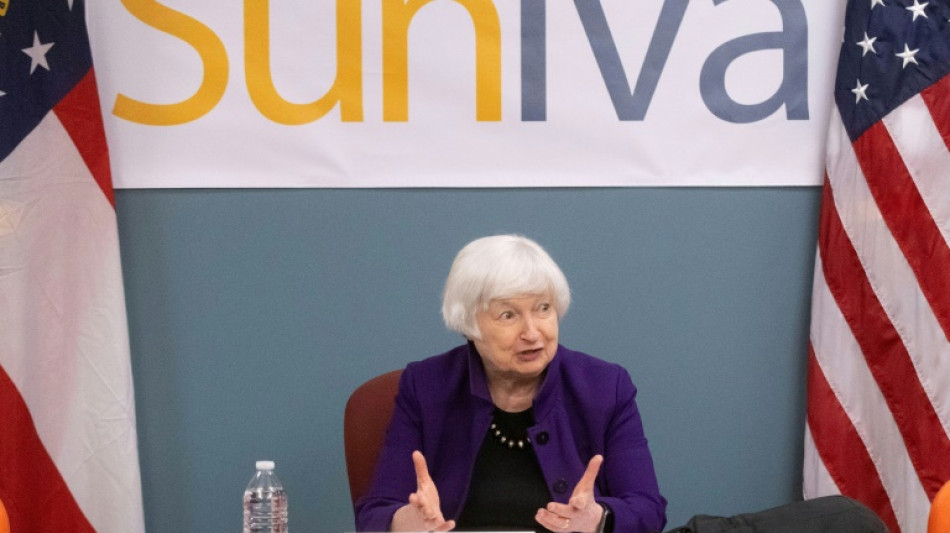
Yellen to warn China of industrial oversupply risks / Photo: CHRISTIAN MONTERROSA - AFP

 Mutual fund returns show shifting leaders across market-cap categories

 IndiGo holds talks with Embraer over potential order for 100 aircraft

 Indian companies report mixed second-quarter results on November 4

 KKR secures Indian regulator approval for Gentari Renewables investment

 Bharti Airtel revenue expected to grow at double-digit pace in second quarter

 Indian crude-sensitive shares gain after 13% oil-price decline

 Stocks and dollar fall as Democratic election gains reshape markets

 Qatar Tourism joins Pacific Asia Travel Association at London travel market

A surge in cheap exports from China in industries like electric vehicles could create an oversupply and hurt economies, US Treasury Secretary Janet Yellen warned in a speech on Wednesday.
She plans to raise those risks during her next trip to China likely this year, and press Beijing to take "necessary steps to address this issue."
In her speech in the southern US state of Georgia, Yellen touted the benefits of President Joe Biden's landmark Inflation Reduction Act and highlighted major business investments that have been announced in response.
But she also raised concerns about the impact that China's excess industrial capacity could have on other countries.
Chinese government support in sectors like steel and aluminum in the past has "led to substantial overinvestment and excess capacity that Chinese firms looked to export abroad at depressed prices," Yellen said.
While this boosted production and employment in China, it "forced industry in the rest of the world to contract," she added.
"Now, we see excess capacity building in 'new' industries like solar, EVs, and lithium-ion batteries," Yellen noted.
The fear is that overcapacity could distort global prices and production, impacting companies and staff.
Yellen added that governments and businesses from other countries are also increasingly raising concerns.
"It is important to the president and me that American firms and workers can compete on a level playing field," said Yellen.
Yellen said she believes excess capacity also poses risks to China's own productivity and economic growth.
In a speech last December, Yellen called for Beijing to shift away from a state-driven approach in economic policy.
US companies have long complained about what they see as an unfair business environment in China.
On Wednesday, the Alliance for American Manufacturing (AAM) urged the US government to help prevent a deluge of Chinese imports.
"We must also ensure that Chinese companies don't simply use our trade partners as a back door to the American market, or to distort it by locating minor operations here dependent on the Chinese supply chain in a way that displaces our emerging industries," said AAM President Scott Paul.
M.Anderson--CPN