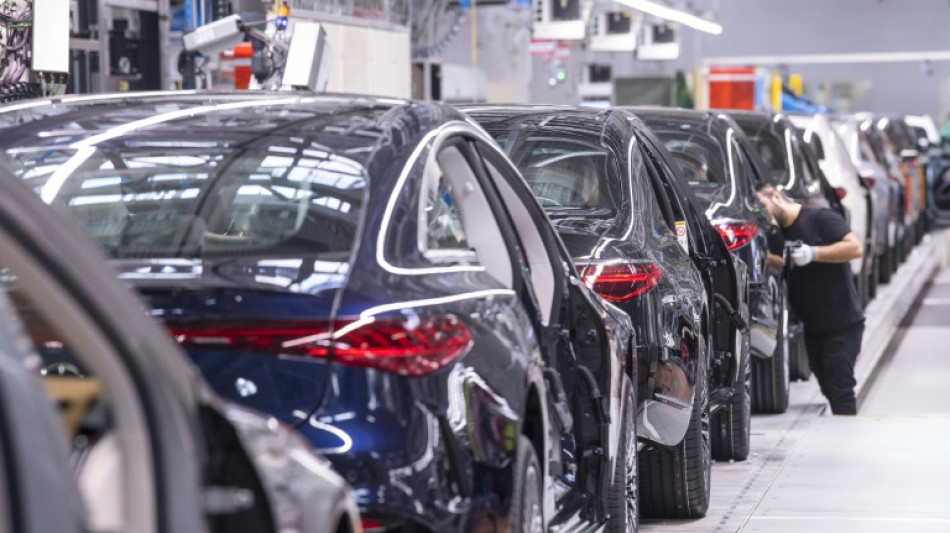
German economy to nearly flatline this year, think-tanks say / Photo: THOMAS KIENZLE - AFP/File

 Mutual fund returns show shifting leaders across market-cap categories

 IndiGo holds talks with Embraer over potential order for 100 aircraft

 Indian companies report mixed second-quarter results on November 4

 KKR secures Indian regulator approval for Gentari Renewables investment

 Bharti Airtel revenue expected to grow at double-digit pace in second quarter

 Indian crude-sensitive shares gain after 13% oil-price decline

 Stocks and dollar fall as Democratic election gains reshape markets

 Qatar Tourism joins Pacific Asia Travel Association at London travel market

The German economy is expected to barely grow this year, leading economic institutes said Wednesday, as weak demand at home and abroad slows the path to recovery.
Europe's largest economy will expand by just 0.1 percent in 2024, five think-tanks said in a joint statement, a sharp downgrade from their earlier forecast of 1.3 percent growth.
"Cyclical and structural factors are overlapping in the sluggish overall economic development," said Stefan Kooths from the Kiel Institute for the World Economy (IfW Kiel).
"Although a recovery is likely to set in from the spring, the overall momentum will not be too strong," he added.
The German economy shrank by 0.3 percent last year, battered by inflation, high interest rates and cooling exports, and is struggling to emerge from the doldrums.
Even though inflation has steadily dropped in recent months, consumer spending was picking up "later and less dynamically" than previously forecast as wages lag behind, the institutes (DIW, Ifo, IfW Kiel, IWH and RWI) said.
And Germany's export sector, usually a key driver of economic growth, was suffering from cooling foreign trade against a fragile global economic backdrop.
Energy-intensive businesses in particular have been hit hard by soaring energy prices following Russia's war in Ukraine, contributing to a manufacturing slump in Europe's industrial powerhouse.
Corporate investments meanwhile have been dampened not just by the European Central Bank's interest rate rises, which have made borrowing more expensive, but also by "uncertainty about economic policy", the institutes said.
- Debt brake debate -
The criticism of Berlin comes after a shock legal ruling late last year threw Chancellor Olaf Scholz's budget into disarray, forcing the government to rethink its spending plans.
The government recently also drastically downgraded its own economic forecasts, expecting output to expand by just 0.2 percent this year.
Economy Minister Robert Habeck last month acknowledged the economy was "in rough waters" and in need of a "reform booster".
But Scholz's three-way coalition government -- made up of the Social Democrats, the Greens and the liberal FDP -- is divided over how to turn the tide.
Calls have grown for the government to relax its constitutionally enshrined "debt brake", a self-imposed cap on annual borrowing, in order to turbocharge much-needed spending on infrastructure modernisation and the green transition.
Habeck is in favour of relaxing the debt rules, but Finance Minister Christian Lindner from the FDP is deeply opposed.
The think-tanks said they recommended "a mild reform" of the debt brake to allow "for more debt-financed investments than before".
Looking ahead, the institutes expect the recovery to quicken next year as inflation eases further and demand picks up.
They now expect the economy to grow by 1.4 percent in 2025, only slightly below their previous forecast of 1.5 percent.
A.Agostinelli--CPN