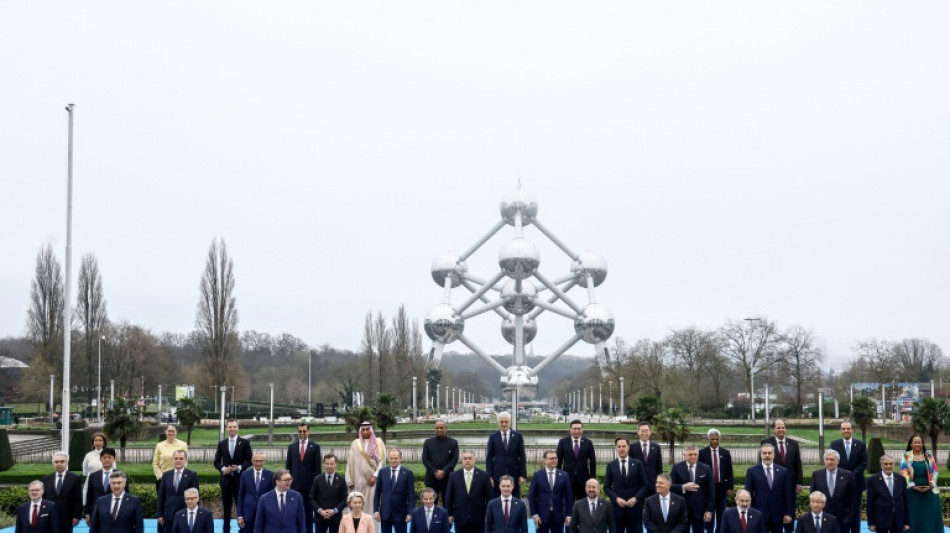
Leaders tout nuclear power as climate tool at Brussels summit / Photo: KENZO TRIBOUILLARD - AFP

 Mutual fund returns show shifting leaders across market-cap categories

 IndiGo holds talks with Embraer over potential order for 100 aircraft

 Indian companies report mixed second-quarter results on November 4

 KKR secures Indian regulator approval for Gentari Renewables investment

 Bharti Airtel revenue expected to grow at double-digit pace in second quarter

 Indian crude-sensitive shares gain after 13% oil-price decline

 Stocks and dollar fall as Democratic election gains reshape markets

 Qatar Tourism joins Pacific Asia Travel Association at London travel market

More than 30 countries -- including European nations, the United States, Brazil and China -- took part on Thursday in the first-ever summit held by the United Nations' atomic energy agency to promote nuclear as a "clean and reliable source of energy".
"This is a fight where we have to use all the available, dispatchable, CO2-free energy sources for the common challenge," International Atomic Energy Agency (IAEA) head Rafael Grossi told the gathering at the Atomium in Brussels -- a modernist landmark built for the 1958 World Fair.
The approach is anathema to a number of other European countries -- including Germany and Spain -- and to many environmentalists, who see the drive for nuclear as a harmful distraction from the need to invest massively, and immediately, in renewables.
The summit follows on from last year's COP28 UN climate negotiations, at which 22 world leaders backed a call to triple the world's nuclear energy capacity by 2050.
"It took 28 conferences on climate change to recognise, at long last, that nuclear should be accelerated," Grossi said. "Better late than never."
Now, said Grossi, the focus was on "what we still need to do" -- including crucially on the question of financing.
Nuclear currently accounts for just under 10 percent of global electricity generation, with 438 plants operating across 31 countries.
More than 500 plants are at various stages of planning and development, with 61 under construction according to World Nuclear Association data.
"I see around the world, nuclear is making a comeback. A very strong comeback," International Energy Agency (IEA) chief Fatih Birol told reporters at the gathering.
Birol attributed the shift chiefly to the quest for carbon-free power sources but also the search for secure and stable energy following Russia's invasion of Ukraine.
He said there was "a key role for nuclear", while also acknowledging that the "major part" of carbon-free electricity needed to come from renewables -- solar, wind and hydro power.
In the European Union, France has been spearheading a drive to establish nuclear as a key source of carbon-free energy in the bloc, which has included it in its roadmap to reaching its 2040 climate goals.
Questioned by reporters about nuclear safety risks, French President Emmanuel Macron pointed to France's decades-long record of producing atomic energy "within a framework that is controlled, understood, mature".
"I say we should be much more worried, for instance, about CO2 emissions that have a direct impact on our health every day," Macron said.
While nuclear plants generate almost no greenhouse gases, critics hightlight that compared to renewables they can take decades to build, are expensive and generate hazardous waste.
The Fukushima nuclear disaster in Japan in 2011 dealt the industry a severe blow and Russia's occupation of the Zaporizhzhia nuclear plant in Ukraine, Europe's largest, has raised alarm in Kyiv about the risks of a new Chernobyl disaster.
To make the point, a Greenpeace activist climbed a wall at the venue with a banner reading "Nuclear Fairy Tale".
P.Schmidt--CPN