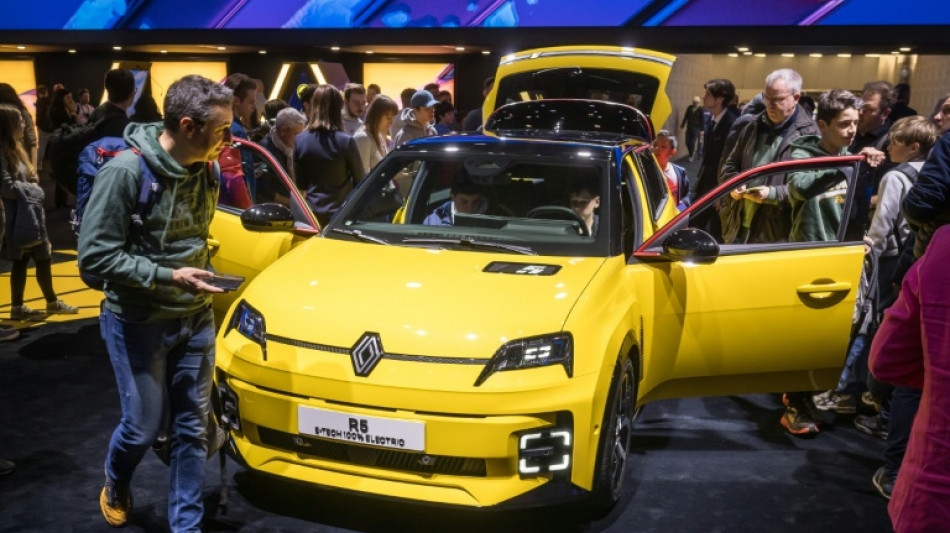
Renault CEO urges 'Marshall Plan' for Europe electric vehicles / Photo: Fabrice COFFRINI - AFP/File

 Mutual fund returns show shifting leaders across market-cap categories

 IndiGo holds talks with Embraer over potential order for 100 aircraft

 Indian companies report mixed second-quarter results on November 4

 KKR secures Indian regulator approval for Gentari Renewables investment

 Bharti Airtel revenue expected to grow at double-digit pace in second quarter

 Indian crude-sensitive shares gain after 13% oil-price decline

 Stocks and dollar fall as Democratic election gains reshape markets

 Qatar Tourism joins Pacific Asia Travel Association at London travel market

The chief executive of French automaker Renault called Tuesday for a European "Marshall Plan" to accelerate the adoption of electric vehicles and reduce carbon emissions in the face of Chinese competition.
The post-WWII US programme helped rebuild Western European economies, and Luca de Meo argued for a similar effort in a series of proposals made to launch a policy debate ahead of European parliamentary elections in June.
"A European Marshall Plan could be put in place to accelerate parc renewal and thus drastically reduce CO2 emissions," he wrote.
He likened it to the EU's post-Covid recovery plan, saying a special European fund could finance incentives for the purchase of new or used electric vehicles (EVs).
Europe aims to phase out the sale of traditional internal combustion engine vehicles by 2035 as part of its efforts to reach carbon neutrality by 2050.
But with "an onslaught of electric vehicles from China", de Meo said the European automotive sector needed the EU to develop an industrial strategy, much like it did to encourage the development of planemaker Airbus, and as the Chinese have done for EVs.
In particular he called for the creation of "green economic zones" like China's special economic zones, with companies receiving additional subsidies and tax breaks to encourage the rapid development of EVs.
He also called for cooperative efforts to build small and affordable vehicles in Europe.
"These cars would also significantly improve air quality in cities," wrote de Meo, noting that one city in four suffers from poor air quality, with 39 percent of emissions being caused by road traffic.
Size also matters, both in terms of environmental impact and cost.
"Driving around every day in an electric vehicle weighing 2.5 tonnes is clearly an environmental nonsense," de Meo said.
Meanwhile, compact cars are 20 to 30 percent cheaper to build, he added.
But efforts to lower the prices of small city cars are needed, as they have more than doubled over the past two decades while wages have risen much less, as are incentives and financing options to ensure consumers can switch to EVs.
He also suggested that Europe's 200 largest cities adopt incentives like offering free access for small zero-emission cars and vans, while making other vehicle owners pay.
S.F.Lacroix--CPN