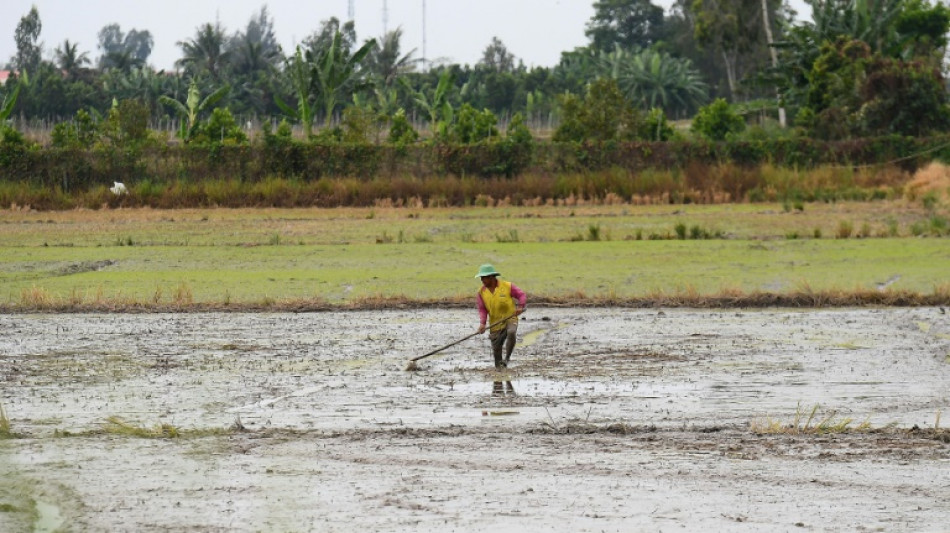
Vietnam faces $3bn annual crop losses from rising saltwater levels / Photo: Nhac NGUYEN - AFP

 Mutual fund returns show shifting leaders across market-cap categories

 IndiGo holds talks with Embraer over potential order for 100 aircraft

 Indian companies report mixed second-quarter results on November 4

 KKR secures Indian regulator approval for Gentari Renewables investment

 Bharti Airtel revenue expected to grow at double-digit pace in second quarter

 Indian crude-sensitive shares gain after 13% oil-price decline

 Stocks and dollar fall as Democratic election gains reshape markets

 Qatar Tourism joins Pacific Asia Travel Association at London travel market

Vietnam faces nearly $3 billion a year in crop losses as more saltwater seeps into arable land, state media reported Sunday, citing new research.
The damage would likely centre on the Mekong Delta region, known as "Vietnam's rice bowl" because it provides food and livelihoods for tens of millions of people, research from the country's environment ministry showed.
Saltwater levels are often higher in the dry season but they are intensifying due to rising sea levels, droughts, tidal fluctuations, and a lack of upstream freshwater.
The resulting crop losses could amount to 70 trillion dong ($2.94 billion), state media VnExpress reported, citing new research from the Water Resources Science Institute, which is under the environment ministry.
The research found among the most impacted parts of the region would be the southernmost Ca Mau province, which could lose an estimated $665 million.
Ben Tre province could face roughly $472 million in losses, according to the study, which was presented Friday at a conference on water resource management.
"With the current scenario, fruit trees account for 29 percent of the damage in Mekong Delta, while crops account for 27 percent, and rice accounts for nearly 14 percent," according to the findings.
"The fisheries industry accounts for 30 percent, equivalent to more than 21,000 billion dong ($840 million)," it added.
Greater losses were forecast for the region in the future, rising over $3.1 billion, the study said.
Earlier this month, the Department of Water Resources warned saline intrusion could impact around 80,000 hectares of rice and fruit farms in the Mekong Delta.
Salt intrusion in the area between 2023-2024 was higher than the average, according to the National Center for Hydro-Meteorological Forecasting.
The delta suffered an unusually long heatwave in February, leading to drought in several areas and low water levels in the region's canals.
L.K.Baumgartner--CPN