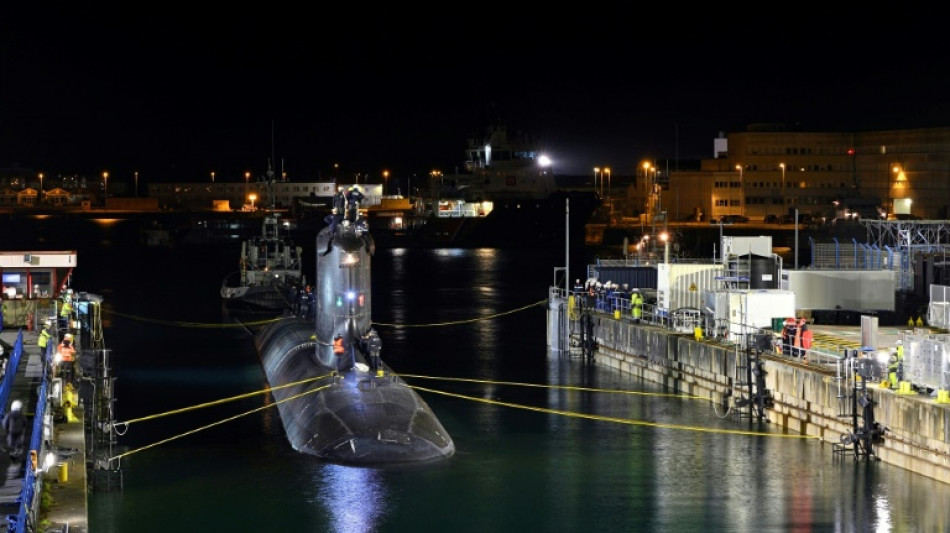
Dutch pick France's Naval Group for submarines deal / Photo: Handout - Naval Group/AFP/File

 Mutual fund returns show shifting leaders across market-cap categories

 IndiGo holds talks with Embraer over potential order for 100 aircraft

 Indian companies report mixed second-quarter results on November 4

 KKR secures Indian regulator approval for Gentari Renewables investment

 Bharti Airtel revenue expected to grow at double-digit pace in second quarter

 Indian crude-sensitive shares gain after 13% oil-price decline

 Stocks and dollar fall as Democratic election gains reshape markets

 Qatar Tourism joins Pacific Asia Travel Association at London travel market

The Netherlands picked French defence company Naval Group on Friday to build four submarines for its navy in a deal worth billions of euros that had also been pursued by Swedish and German firms.
The decision is a boon for Naval Group, coming three years after it abruptly lost a major contract to build 12 Barracuda submarines for Australia.
The Netherlands picked the French firm and its Dutch partner Royal IHC over Germany's Thyssenkrupp Marine Systems (TKMS) and Swedish defence group Saab AB, which was bidding with Dutch shipyard Damen.
"With the choice of Naval Group, two naval yards didn't win and I understand that the disappointment is large," state secretary for defence Christophe van der Maat said in Den Helder, home to the country's biggest naval base.
The French firm "succeeded in offering a balanced, versatile and realistic offer. Dutch industry also has an important role to play, an important condition in the award process," he said.
The vessels will replace the Netherland's four Walrus class subs which entered service in the early 1990s, of which one was decommissioned last autumn so that its spare parts could be used to keep the other three in operation.
Parliament will have to approve the contract, and caretaker Prime Minister Mark Rutte's cabinet has tried to speed up the decision ever since the party of far-right winger Geert Wilders won the most votes in last November's election.
Wilders conceded Wednesday that he was unable to cobble together a coalition and the country's main parties agreed to form a "technocratic" government made up of non-politicians.
During a parliamentary debate Wednesday, Chris Stoffer from the reformist SGP party -- which is strong in Zeeland where Damen is based -- asked that "we do not let this government decide, but a new government that will decide in the interests of the Netherlands."
Van der Maat has said he wants to move quickly to avoid having to withdraw the aging Walruses from service before the new submarines are ready to deploy.
The deal had been reported by Dutch media for days, with newspaper De Telegraaf saying the contract would be worth between four billion and six billion euros ($4.4-6.5 billion).
Countries in Europe have stepped up military spending in the wake of Russia's invasion of Ukraine.
France has replaced Russia as the world's second largest arms exporter behind the United States, the Stockholm International Peace Research Institute (SIPRI) said in a report on Monday.
- First Barracuda export -
The submarines would be built in the shipyards of whatever company wins the contract, but there would also be an industrial cooperation accord to "reinforce the technological and industrial base of the Dutch defence industry", according to the defence ministry.
The first two subs would enter service within 10 years of the contract signing.
It will be Naval Group's first exports of its Barracuda model, of which 12 were to be sold to Australia before Canberra cancelled the contract in 2021 in favour of a deal with Britain and the United States, causing a diplomatic storm.
The first Barracuda to enter service in the French navy was nuclear-powered, but the model offered to the Netherlands would have conventional diesel-electric propulsion and be smaller at 3,000 tonnes, instead of 4,500 tonnes.
TKMS, which by some counts holds 70 percent of the market for conventional submarines, had offered an extended version of its Type 212CD, a vessel adapted to shallow waters such as the Baltic Sea.
Saab had proposed an extended version of its A26 submarine that has been ordered by the Swedish navy.
A.Samuel--CPN