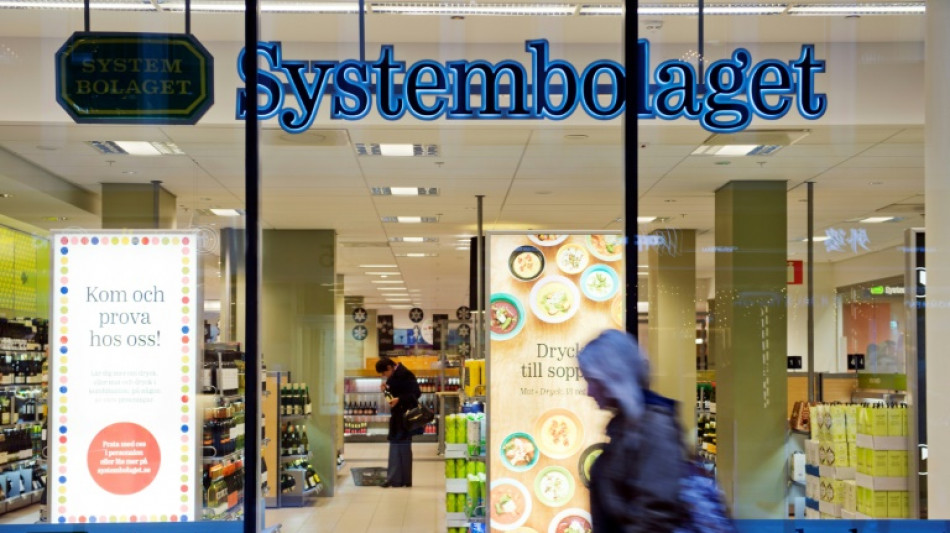
Economic hard times make Swedes cut back on drinking / Photo: JONATHAN NACKSTRAND - AFP/File

 Mutual fund returns show shifting leaders across market-cap categories

 IndiGo holds talks with Embraer over potential order for 100 aircraft

 Indian companies report mixed second-quarter results on November 4

 KKR secures Indian regulator approval for Gentari Renewables investment

 Bharti Airtel revenue expected to grow at double-digit pace in second quarter

 Indian crude-sensitive shares gain after 13% oil-price decline

 Stocks and dollar fall as Democratic election gains reshape markets

 Qatar Tourism joins Pacific Asia Travel Association at London travel market

A slumping economy gave Swedes less to cheer about last year as alcohol consumption fell the most in nearly a decade in the Nordic country, excluding the 2020 pandemic, research showed Friday.
Alcohol consumption among people above the age of 15 fell to 8.6 litres per capita in 2023, according to the Swedish Council for Information on Alcohol and Other Drugs (CAN)
It was down 2.7 percent from 2022, the biggest annual drop since 2014 when excluding 2020.
"This shows that the economic situation in 2023 has also influenced the buying of alcohol," Bjorn Trolldal, a researcher at CAN, said in a statement.
"The depreciation of the Swedish krona and the increase in fuel prices has affected imports," the researcher told AFP.
As a result, Swedes bought less alcohol from Germany, which accounts for 50 percent of total imports, he added.
The country's economy shrank by 0.3 percent in 2023, one of the weakest performers in the European Union, as the central bank raised rates to battle soaring inflation.
Sweden has an alcohol distribution monopoly, meaning that apart from bars and restaurants Swedes can only buy beverages with an alcohol-level above 3.5 percent at state-run outlets called Systembolaget, and authorised retailers in rural areas.
Systembolaget accounted for around 71 percent of total consumption in 2023, up from 64.8 percent in 2019, according to the study.
Alcohol consumption is steadily declining in Sweden, having dropped by around 10 percent since 2014.
A.Samuel--CPN