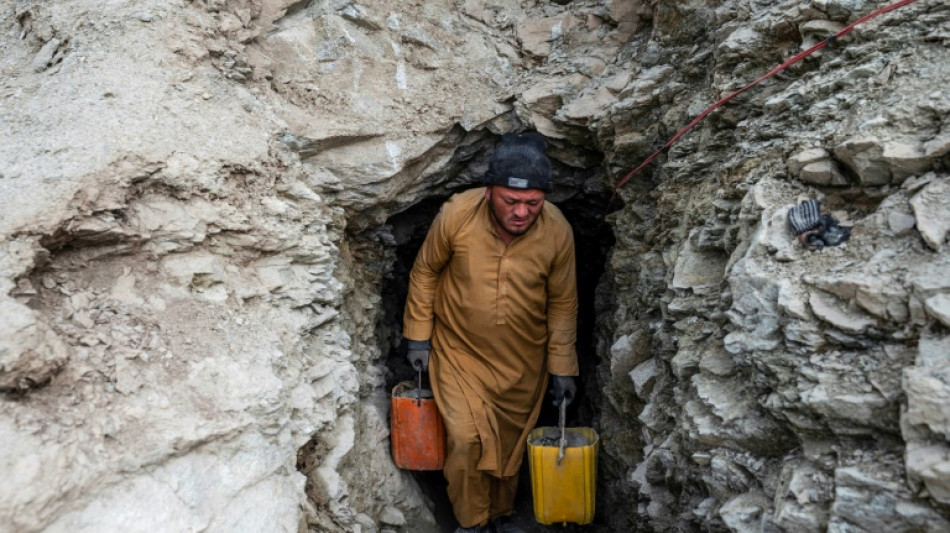
Unemployed Afghans risk death and debt in hunt for gold / Photo: Wakil KOHSAR - AFP

 Mutual fund returns show shifting leaders across market-cap categories

 IndiGo holds talks with Embraer over potential order for 100 aircraft

 Indian companies report mixed second-quarter results on November 4

 KKR secures Indian regulator approval for Gentari Renewables investment

 Bharti Airtel revenue expected to grow at double-digit pace in second quarter

 Indian crude-sensitive shares gain after 13% oil-price decline

 Stocks and dollar fall as Democratic election gains reshape markets

 Qatar Tourism joins Pacific Asia Travel Association at London travel market

Tearing off a piece of mouldy flatbread, Homayon gulped tea in a brief reprieve from the din of the machines he and a dozen other men were using to dig for gold on a mountainside in northeastern Afghanistan.
The 30-year-old found little work as a mechanic in nearby Faizabad city, so he banded with other unemployed men to try their luck carving out a living in the rocky mountains that dominate Badakhshan province.
"Five, six of us were jobless, we came here to see if we can find anything," Homayon told AFP, as the handful of men finished their break and returned to work at the small-scale mine they had set up.
Their efforts digging four tunnels have borne little fruit, even as they pour money into fuel, tools and labour.
Other mines in the area had proved productive, Homayon said, so they kept digging -- the promise of a windfall outweighing the risks of debt.
The losses can be significant, warned fellow miner Qadir Khan.
"There are people who went into debt and were not able to find anything from these kinds of tunnels," he said.
"They lost two to three hundred thousand (Afghanis, or roughly $2,800-$4,200), and there was nothing to do but try to find different work, make money, and come back to pay their debts."
- Sifting through rocks -
Despite being 74, Khan says he has no choice but to keep working, as he hunches over a pile of rocks to break them into smaller pieces.
The Afghan Taliban's takeover of the country in 2021 may have seen an end to two decades of war with the United States and its allies, but, according to a World Bank report, half the population is still living in poverty.
Labourer Sharif, 60, said he used to keep livestock but has been mining for the last year. Two of his sons had left for Iran to find work.
"We are still farming, but it is not the way it used to be," he said, complaining of a lack of water -- another shortage drought-hit Afghanistan has faced in recent years.
The rocks Sharif helps mine are broken up and hoisted down the steep mountainside, then pulverised into a flour-like substance.
On the banks of the Kokcha River, which snakes between snow-capped peaks, men use makeshift buckets to scoop water over piles of the powder. It is then sifted as it runs down a sluice covered by material pulled from car interiors.
The proceeds of the first wash are used to fund the equipment and labour and to keep the mine going. The gains from the second and third washes are shared between those bankrolling the operation.
- Dangerous work -
A young man stopped swirling water around a shallow dish to separate the powdery rock from gold, pulling from his pocket a bit of plastic wrapped around 4,000 Afghanis-worth of the precious metal.
As of late February, 4.5 grams (0.16 ounces) of the precious metal could be sold for 18,000 Afghanis (about $250), Homayon said.
Global gold prices hit an all-time high of $2,141.79 per ounce on March 5.
Even if the miners can collect significant amounts of gold, a fifth of proceeds will go to the Taliban authorities.
Delving deep into the Afghan mountains, the miners risk not just debt, but death as well.
Mine collapses are common in Afghanistan, which is rich with precious minerals like the lapis lazuli Badakhshan is famous for.
The miners on the Kokcha said they had lost friends recently, and local media reported earlier this month that a gold miner died when part of a mine collapsed in neighbouring Takhar province.
In 2019, at least 30 people were killed when a gold mine collapsed in Badakhshan.
Despite the risks, the men continue digging.
"So far we have not found much of anything," said Homayon. "But we have hope, we trust in God."
M.Mendoza--CPN