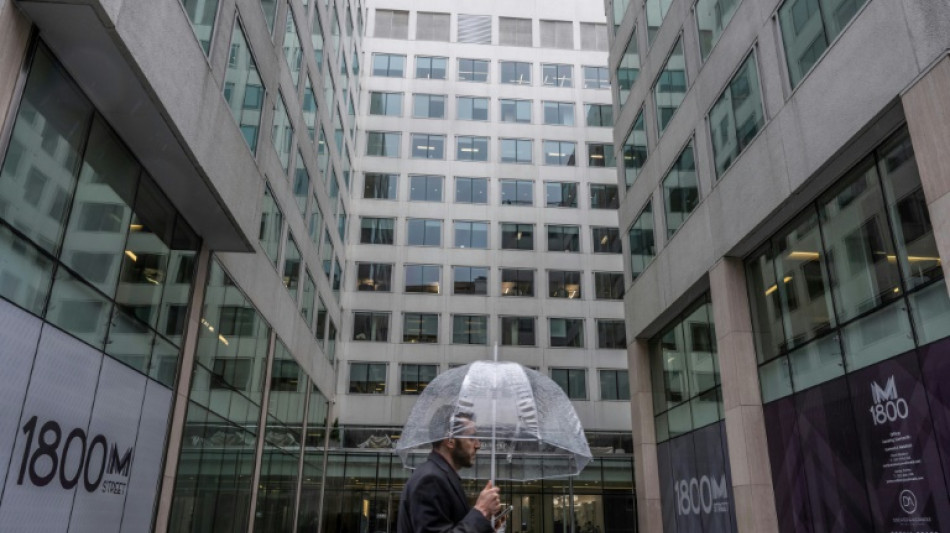
US embrace of remote working empties offices, weighs on banks / Photo: ANDREW CABALLERO-REYNOLDS - AFP

 Mutual fund returns show shifting leaders across market-cap categories

 IndiGo holds talks with Embraer over potential order for 100 aircraft

 Indian companies report mixed second-quarter results on November 4

 KKR secures Indian regulator approval for Gentari Renewables investment

 Bharti Airtel revenue expected to grow at double-digit pace in second quarter

 Indian crude-sensitive shares gain after 13% oil-price decline

 Stocks and dollar fall as Democratic election gains reshape markets

 Qatar Tourism joins Pacific Asia Travel Association at London travel market

The popularity of remote work in the United States has emptied office buildings, a cause for worry as their value falls and owners risk losses on property loans -- in turn putting pressure on smaller banks.
"There will be bank failures, but this is not the big banks," said US Federal Reserve Chair Jerome Powell on Thursday.
In San Francisco, Washington and even New York, offices have been seeing half the number of people as before the pandemic, with white-collar workers reluctant to return to commuting.
Office vacancy rates across the country have risen to 13.5 percent in 2023 from 9.5 percent in 2019, and could hit 16.6 percent at the end of next year, said credit company Fitch Ratings in a December report.
"In many cities, the downtown office district is very underpopulated," Powell told a Congressional hearing this week.
With empty buildings in cities of all sizes, retailers servicing employees who used to work there are also under pressure, Powell added.
- Lost value -
The shift in work patterns has caused the commercial real estate sector to lose a third of its value, which could have a wider impact.
Of $737 billion in office property mortgages, $206 billion -- around a quarter -- are set to mature this year, according to the Mortgage Bankers Association.
But this comes as interest rates are at their highest in more than 20 years.
This means that when loans come due, they will need to be refinanced where vacancy rates are high in some cities and valuations are lower.
In the United States, commercial loans must be renegotiated every three to five years.
The risk is a "chain reaction" where banks "risk seeing their borrowers default and as a result, experience stress on their capital," said EY chief economist Gregory Daco.
- Stresses -
National Economic Advisor Lael Brainard told reporters recently that she expects "stress" but not "broader implications for the financial system."
"We're talking about office properties where vacancies are high due to changes in patterns of work use," she added.
"It's a narrow class within the broader commercial real estate," Brainard said.
While large establishments have the capacity to absorb some losses, these could prove a massive blow to smaller banks, Daco said.
Retirement funds or insurance companies, among others, could also be impacted if they have commercial buildings in their portfolios.
These may be even more vulnerable, as they are not subject to the same regulatory requirements as banks.
- 'Domino effect' -
Powell noted that the Fed works with establishments that face risks, saying: "We have identified the banks that have high commercial real estate concentrations, particularly office and retail."
"We are in dialogue with them," he added.
"If properties are sold for less than financial institutions anticipate, it could set off a domino effect, causing banks to reassess the potential losses they are exposed to in office and the needed credit loss provisions to cover them," said Ryan Sweet, chief US economist at Oxford Economics.
This was one of the weaknesses the embattled New York Community Bancorp faced as its stock tumbled last week.
In January, it reported a $185 million provision for the recently ended quarter, on the back of a deterioration in its real estate loan portfolio.
It has since lined up more than $1 billion from investors led by the firm of former US Treasury Secretary Steven Mnuchin.
Fed Governor Michelle Bowman warned last month of the broader situation that "if we don't see more people returning to offices and to work, this is going to become a longer-term problem."
Y.Ponomarenko--CPN