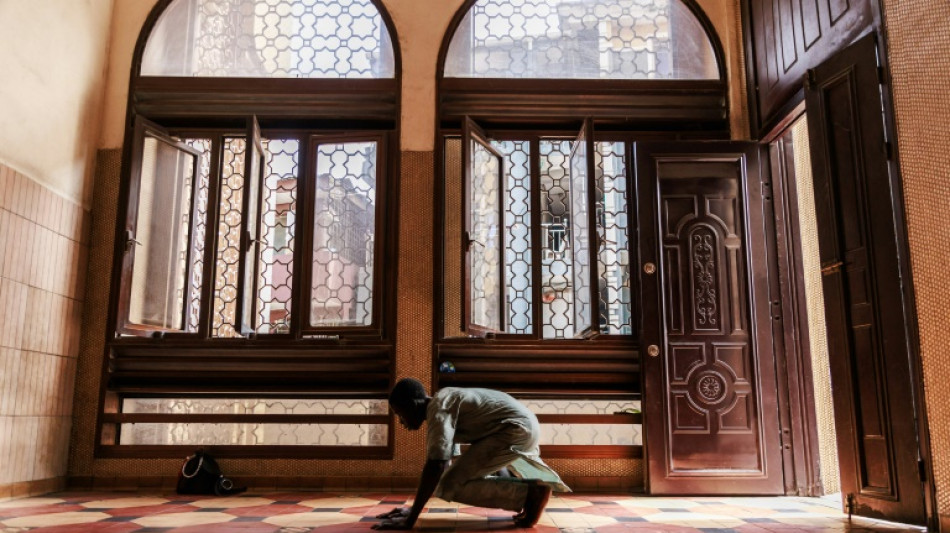
Soaring food prices dampen Ramadan spirits in Nigeria
/ Photo: Benson Ibeabuchi - AFP

 Mutual fund returns show shifting leaders across market-cap categories

 IndiGo holds talks with Embraer over potential order for 100 aircraft

 Indian companies report mixed second-quarter results on November 4

 KKR secures Indian regulator approval for Gentari Renewables investment

 Bharti Airtel revenue expected to grow at double-digit pace in second quarter

 Indian crude-sensitive shares gain after 13% oil-price decline

 Stocks and dollar fall as Democratic election gains reshape markets

 Qatar Tourism joins Pacific Asia Travel Association at London travel market

The holy fasting month of Ramadan begins early next week in Nigeria, with the worst economic crisis in a generation leaving many in Africa's most populous Muslim country struggling to buy food.
With food inflation at around 35 percent, worshippers taking part in Friday prayers at the central mosque in Lagos told AFP they were barely able to provide for their families.
"Some people already started fasting because they can't afford to eat," said Owoyemi Sherifent Mojisola, 54, in the mosque in Nigeria's economic capital.
"Everything is expensive at the moment."
The government brought in reforms last year that have had a devastating effect on citizens of Africa's biggest economy, where around half the population of 220 million is Muslim.
Since coming to office last year, President Bola Ahmed Tinubu has ended a fuel subsidy and currency controls, leading to a tripling of petrol prices and a spike in living costs as the naira has slid against the dollar.
Tinubu has called for patience to allow his reforms to take effect, saying they will help attract foreign investment, but the measures have hit people hard.
Many poor Nigerians have had to skip meals and give up products such as meat, eggs and milk.
"It's really hard," said Idihabom Nafisah Oyebanji, a 42-year-old mother at the central mosque, who said she was unable to afford her favourite Ramadan foods, including milk and melon.
- Food insecurity -
At the market on the outskirts of the mosque, traders also said they were struggling.
"People no longer have money to pay for small pleasures for Ramadan," said incense-seller Azeez Shelifiu.
He said that in under six months, his monthly income had fallen by a third to around 40,000 naira ($25).
Nigeria's economic crisis has triggered sporadic social unrest in recent months.
Earlier this week, the national emergency agency said it had tightened security at its warehouses after hundreds of people looted a food store in the capital Abuja.
- Call for solidarity -
In the face of such hardship, the imam at the central mosque, Sulaiman Oluwatoyin Abou-Nolla, called for solidarity.
"We need to support each other especially during this period of Ramadan," he told AFP, outlining plans to distribute food at the mosque this month.
He warned the economic crisis was fuelling other problems in Nigeria, including kidnappings for ransom.
"It's an economic factor and can be political. The rate of employment is high -- industries are closing," he said.
Nigeria's latest mass kidnapping took place on Thursday in the northwestern state of Kaduna, where gunmen abducted more than 250 school pupils.
At least 63 percent of Nigeria's population lives in extreme poverty, according to the national bureau of statistics.
A.Levy--CPN