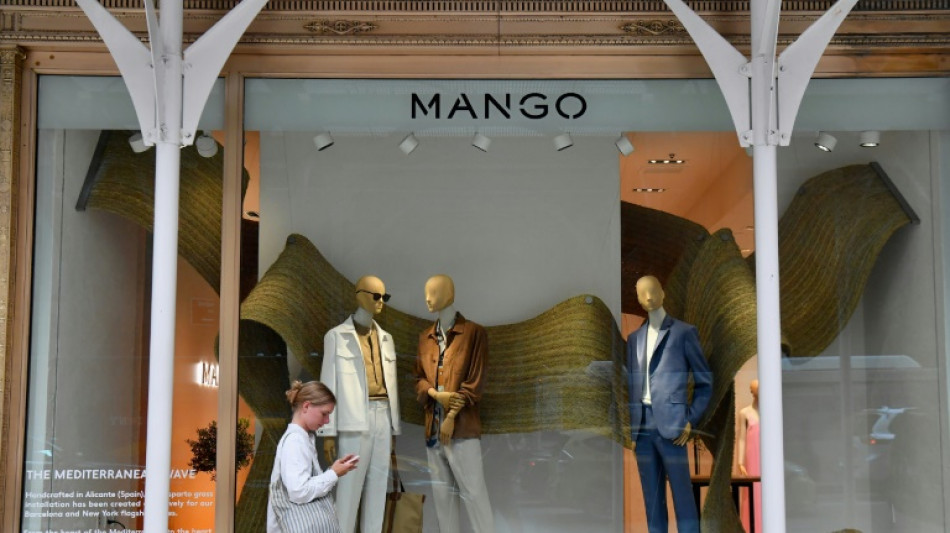
Spain's Mango clothing chain ramps up global expansion / Photo: Angela Weiss - AFP/File

 Mutual fund returns show shifting leaders across market-cap categories

 IndiGo holds talks with Embraer over potential order for 100 aircraft

 Indian companies report mixed second-quarter results on November 4

 KKR secures Indian regulator approval for Gentari Renewables investment

 Bharti Airtel revenue expected to grow at double-digit pace in second quarter

 Indian crude-sensitive shares gain after 13% oil-price decline

 Stocks and dollar fall as Democratic election gains reshape markets

 Qatar Tourism joins Pacific Asia Travel Association at London travel market

Spanish fashion retailer Mango, founded 40 years ago in Barcelona, is ramping its global expansion despite economic uncertainties that have shaken some other global mass-market apparel giants.
After a slowdown sparked by the Covid-19 pandemic, the family-owned company has in recent months inaugurated several large stores around the globe.
They include a 400-square-metre (1,300-square-foot) space in Los Angeles, a similar-sized one in Manchester, England, and a flagship store in India's tech hub of Bengaluru.
Mango has opened a total of 115 stores over the past year, mainly in the United States where its sales outlets have tripled, the company's global retail director, Cesar de Vicente, said in an interview with AFP.
It has more than 2,700 stores in over 115 countries, compared to nearly 6,000 worldwide for Zara-owner Inditex, Spain's other clothing retail success story.
The expansion has helped boost turnover with Mango expecting to post over three billion euros ($3.3 billion) in sales in 2023 -- a record -- when it announces its yearly results on Monday, De Vicente told AFP as he stood in front of prototypes of new garments at the company's sprawling headquarters in a Barcelona suburb.
It is at this building -- dubbed the "campus" -- that the textile group which employs 500 stylists designs and tests its future collections.
The company sells nearly 160 million items of clothing and accessories a year.
- Star ambassadors -
Mango traces its origins to 1984 when a young man of Turkish origin, Isak Andic, opened his first shop on the Paseo de Gracia, Barcelona's famous shopping street, with the help of his older brother Nahman which was hugely succesful.
Spain had just emerged from a decades-long dictatorship which ended with the death of General Francisco Franco in 1975 and consumers were hungry for more modern clothes.
"He saw that we needed colour, style," said De Vicente.
Andic quickly opened dozens of more stores in Spain and then abroad, starting in neighbouring Portugal and France, all under the name Mango.
To help boost sales the company has hired big stars such as British model Kate Moss, Spanish actress Penelope Cruz, and French footballer Antoine Griezmann for its marketing campaigns.
Like its main domestic rival Inditex, the world's biggest fashion retailer whose other store brands include Bershka and Pull&Bear, Mango strives to quickly adjust its production to the latest fashion trends while offering affordable prices.
The two groups "have many similarities" because they "developed at the same time" but there are some significant differences, said Marcel Planellas, a strategy professor at Barcelona business school Esade.
Mango has just a single brand and it does not own any factory, outsourcing its production mainly to lower-cost Turkey and Asia, he added.
- 500 new stores -
The company, which employs some 14,000 people and aims to differentiate itself from low-cost brands such as Shein and Primark by accelerating its move upmarket, will present its new strategic plan on Monday along with its annual results.
It is expected to confirm its international ambitions, with 500 new stores planned by 2026.
These openings will mostly take place in the United States, the UK and France, the group's second-largest market after Spain, said De Vicente.
This dynamism contrasts with the sluggishness seen elsewhere in the sector in Europe where US retailer Gap has closed shops and French retail clothing company Camaieu, which made and sold its own collections of women's fashion, closed down at the end of 2022.
Mango enjoys a "solid situation" unlike some of its competitors, said Planellas, who predicts the company will list on the stock market in the coming years as Inditex did in 2001.
X.Wong--CPN