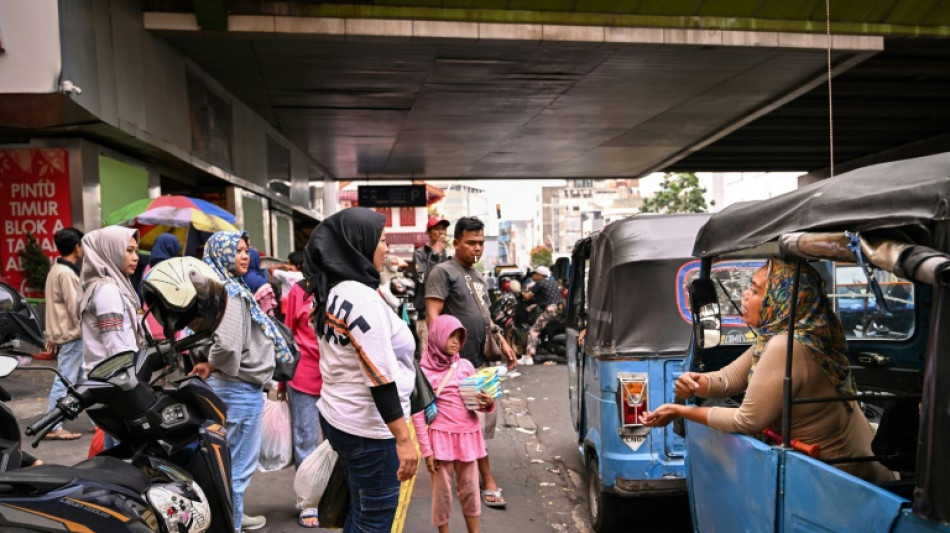
Indonesian single mom makes ends meet as autorickshaw driver / Photo: Adek BERRY - AFP

 Mutual fund returns show shifting leaders across market-cap categories

 IndiGo holds talks with Embraer over potential order for 100 aircraft

 Indian companies report mixed second-quarter results on November 4

 KKR secures Indian regulator approval for Gentari Renewables investment

 Bharti Airtel revenue expected to grow at double-digit pace in second quarter

 Indian crude-sensitive shares gain after 13% oil-price decline

 Stocks and dollar fall as Democratic election gains reshape markets

 Qatar Tourism joins Pacific Asia Travel Association at London travel market

Her three-year-old daughter at her side, single mother Ekawati plies Jakarta's notorious traffic in her three-wheeled autorickshaw, making ends meet as one of a growing number of Indonesian women seeking informal employment outside the home.
Not that Ekawati has much choice -- after her first husband died and she divorced her second, it's on her to pay rent and support her four kids, pulling in around 150,000 rupiah ($10) a day picking up fares outside the bustling textile hub of Tanah Abang Market.
"Driving a three-wheeled taxi is the fastest way to get money. I have tried various jobs but this is the most convenient one," said the 42-year-old, who has been driving her rented vehicle for about 15 years.
Her eldest son, now 20, dropped out of school and works as a courier to help out, but Ekawati says she still lives hand to mouth, as covering her 800,000-rupiah rent and feeding her kids takes up all of her earnings.
According to data from Statistics Indonesia (BPS), 12.72 percent of Indonesian households in 2022 had women breadwinners, mostly in urban areas. The number of women homemakers, meanwhile, began to decline during the pandemic.
At the same time, many Indonesian women have moved into informal employment in the service and agriculture sectors to support their families following a major reduction in official job prospects during the Covid years, according to the World Bank.
Ekawati's second child passed away due to an illness, but she managed to send her son to an elementary school with assistance from the local government.
Now she is attempting to get similar aid for her other son who is in junior high.
"I have to drive this three-wheeler so I can give my children proper food, clothes and a house," Ekawati said, tears in her eyes.
"I hope God gives me good health. I also hope my children will be successful, unlike myself."
Working in a male-dominated environment, Ekawati said she had to be tough to make it on the streets, where sexual harassment and extortion by thugs are prevalent.
"Once a passenger asked me to sleep with him for 500,000 rupiah. I immediately asked him to get out of the vehicle," she said.
"As a woman, I don't want to be weak. I must be strong because I make a living on and from the street. No one will help me, except myself."
A.Samuel--CPN