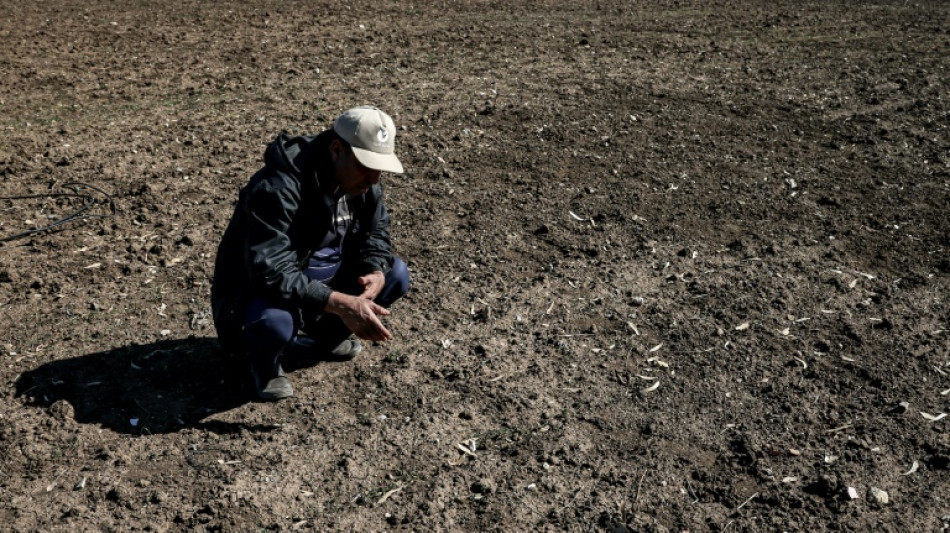
Morocco winter breaks heat records: meteorologists / Photo: FADEL SENNA - AFP/File

 Mutual fund returns show shifting leaders across market-cap categories

 IndiGo holds talks with Embraer over potential order for 100 aircraft

 Indian companies report mixed second-quarter results on November 4

 KKR secures Indian regulator approval for Gentari Renewables investment

 Bharti Airtel revenue expected to grow at double-digit pace in second quarter

 Indian crude-sensitive shares gain after 13% oil-price decline

 Stocks and dollar fall as Democratic election gains reshape markets

 Qatar Tourism joins Pacific Asia Travel Association at London travel market

Morocco experienced record heat this winter, including the hottest January since measurements began, the country's meteorological department told AFP, placing the blame on climate change.
The North African kingdom, where temperatures recently approached 37 degrees Celsius (99 Fahrenheit), is facing a sixth consecutive year of drought.
The lack of water threatens the viability of agriculture -- a key economic sector which employs around a third of the working-age population and accounts for 14 percent of exports.
In January, the average temperature hit a record, "exceeding 3.8C (38.8F) above normal for the period 1991-2020," said Houcine Youaabed, the head of communications for the meteorological department.
It is the "hottest month of January since the first measurements in 1940," he told AFP.
The previous record was set in January 2016, when the average temperature was 2.9C (37.2F) above normal.
In February, several regions experienced temperatures 10C above the usual average for that month, the department said.
Multiple records tumbled, including in the coastal town of Safi, in Morocco's west, which hit 35.6C (96F).
"These recent events in Morocco are part of a global trend," and "reflect the consequences of global warming, including an intensification of meteorological phenomenons," said Youaabed.
Data compiled by AFP using the European Union's Copernicus Programme for Earth observation, show more than a fifth of Europe and the Mediterranean region is classed as being in drought conditions, with 17.3 per cent suffering a humidity deficit, which would place it in the "warning category".
Rain is expected to return to Morocco in the coming days, but only major downpours would be enough to make a dent in the water deficit after the years of drought.
P.Schmidt--CPN