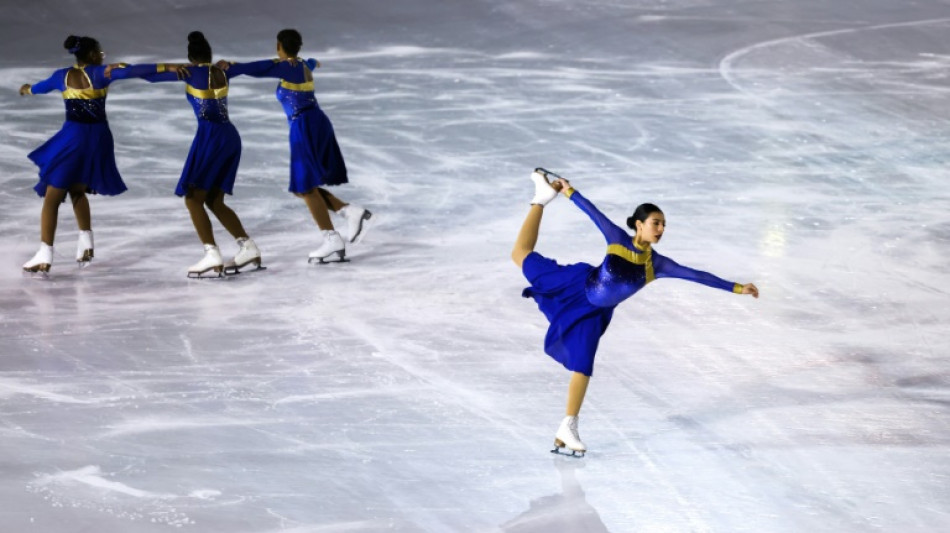
'Powerful and free': Black figure skaters take to the ice in New York / Photo: Charly TRIBALLEAU - AFP

 Mutual fund returns show shifting leaders across market-cap categories

 IndiGo holds talks with Embraer over potential order for 100 aircraft

 Indian companies report mixed second-quarter results on November 4

 KKR secures Indian regulator approval for Gentari Renewables investment

 Bharti Airtel revenue expected to grow at double-digit pace in second quarter

 Indian crude-sensitive shares gain after 13% oil-price decline

 Stocks and dollar fall as Democratic election gains reshape markets

 Qatar Tourism joins Pacific Asia Travel Association at London travel market

One by one, a line of young African American and biracial women dressed in ball gowns took to the ice in New York's Central Park to the soundtracks of "Barbie" and "Wonder Woman."
"Figure Skating in Harlem" (FSH) was staging its annual winter show before a delighted audience under a bright moon, its light reflecting off the glistening rink.
Most of the 300 students who participate in FSH's programs every year live in Harlem or the Bronx.
They are among the poorest corners of New York, a city of 8.5 million riven by inequality despite being an economic engine of the United States.
Adorned in mustard yellow, six of the amateur ice skating enthusiasts effortlessly twirled on the ice, moving together in a synchronized choreography reminiscent of ballet.
When the nonprofit FSH, located on the densely populated, multicultural north side of Manhattan island, was founded in the 1990s, figure skating was "not a sport that many Black and brown girls participated in," said FSH's founder Sharon Cohen.
FSH skater Nadia Neil, 17, told AFP the program was her "whole life."
"I don't remember a time in my life before Figure Skating in Harlem," she said, having joined at the age of six.
"I started to slowly learn and evolve and grow. And it was a really beautiful thing. I felt like a butterfly emerging from a cocoon," said fellow figure skating student Ashley Prentice.
"I just feel like whenever I skate, I feel so powerful and free," said Prentice, a Black teenager who described finding family and community through FSH.
- Opening doors -
The idea of bringing figure skating to Harlem dates back to 1991 when several Black families and Cohen, a white former professional ice skater now in her 60s, got together.
"It was really the community itself that built this program, year after year," Cohen said.
Tailored to school-age children, FSH also offers academic support.
"Education was really the foundation. That's what could open up many more doors for their future," said Cohen.
Almost all of its women and girls, aged between 5 and 30 years old, identify as Black, Hispanic or mixed, and more than nine in 10 are from low- or middle-income households, FSH says.
- 'Support they need' -
"Sometimes, young girls in Harlem don't get that support that they need," said Neil, adding that some get "led down a wrong path."
At FSH, she is able to take advantage of vocational evening classes to supplement her studies.
Cohen said that ice skating mirrors life's challenges: "You begin by failing. You get on the ice and you fall."
"It's uniquely about learning what you do once you fall, and how you get back up, and do it again. And that there's nothing wrong with failing."
The group says that success -- and failure -- on the rink, as well as the academic support, have lasting effects.
Almost 90 percent of FSH's enrollees go on to get top marks at school, with many going on to higher education, according to the organization.
P.Petrenko--CPN