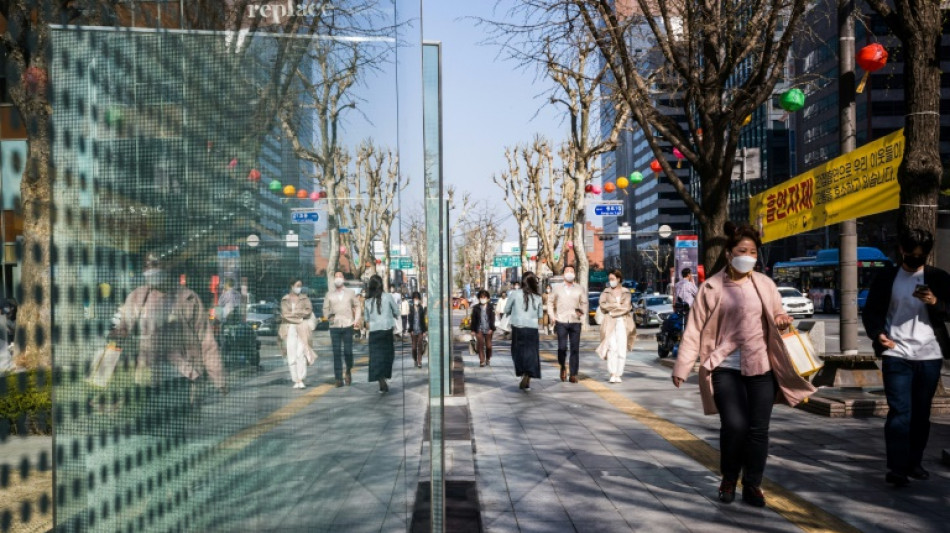
South Korea birth rate falls to all-time low / Photo: Anthony WALLACE - AFP/File

 Mutual fund returns show shifting leaders across market-cap categories

 IndiGo holds talks with Embraer over potential order for 100 aircraft

 Indian companies report mixed second-quarter results on November 4

 KKR secures Indian regulator approval for Gentari Renewables investment

 Bharti Airtel revenue expected to grow at double-digit pace in second quarter

 Indian crude-sensitive shares gain after 13% oil-price decline

 Stocks and dollar fall as Democratic election gains reshape markets

 Qatar Tourism joins Pacific Asia Travel Association at London travel market

South Korea's birth rate fell to a record low last year, the government said on Wednesday, despite having poured billions of dollars into efforts to encourage women to have more children and maintain population stability.
The country has one of the world's longest life expectancies and lowest birth rates, a combination that presents a looming demographic challenge.
South Korea's fertility rate -– the number of children a woman is expected to have in her lifetime -– dropped to 0.72 in 2023, down nearly 8 percent from 2022, according to preliminary data from Statistics Korea.
This is far below the 2.1 children needed to maintain the current population of 51 million.
At these rates, South Korea's population will nearly halve to 26.8 million by 2100, according to the Institute for Health Metrics and Evaluation at the University of Washington in Seattle.
"The number of newborns in 2023 was 230,000, which was 19,200 fewer than the year before, representing a 7.7 percent decrease," Lim Young-il, head of the Population Census Division at Statistics Korea, told reporters.
The 2023 crude birth rate -– the number of newborns per 1,000 people -– was 4.5, down from 4.9 in 2022.
Seoul has poured hundreds of billions of dollars into trying to encourage South Koreans to have more babies, offering cash subsidies, babysitting services and support for infertility treatment, but to no avail, with the fertility rate continuing to plummet to new lows.
"The number of newborns, birth rates, and crude birth rates are all at the lowest point since 1970" when data collection began, the official said, noting that South Korea's 0.72 birth rate is the lowest among the OECD nations.
He added that the average age for South Korean women to give birth was 33.6, which is the highest among OECD members.
Experts say there are multiple causes for the low birth rate, from high child-rearing costs and property prices to a notoriously competitive society that makes well-paid jobs difficult to secure.
The double burden for working mothers of carrying out the brunt of household chores and childcare while also maintaining their careers is another key factor, they say.
T.Morelli--CPN