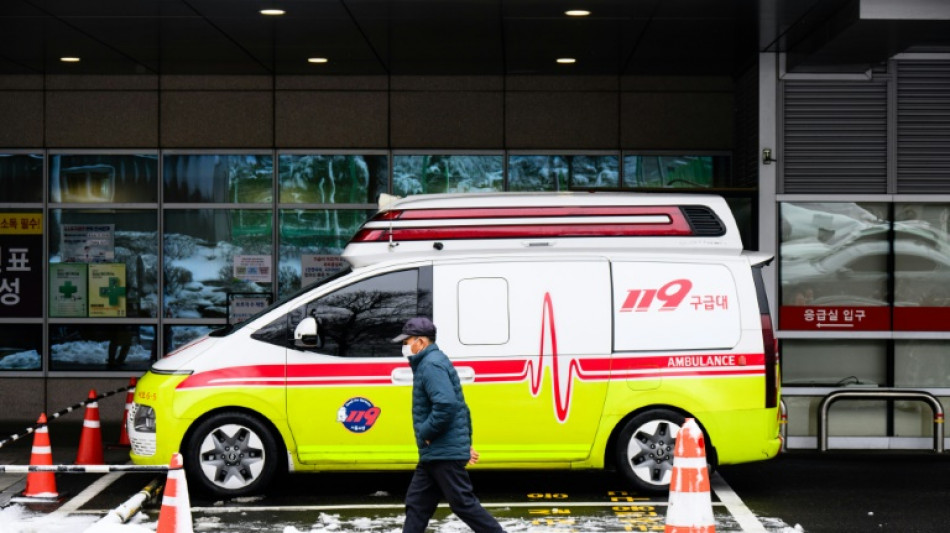
S. Korea empowers nurses as doctors' strike continues / Photo: ANTHONY WALLACE - AFP/File

 Mutual fund returns show shifting leaders across market-cap categories

 IndiGo holds talks with Embraer over potential order for 100 aircraft

 Indian companies report mixed second-quarter results on November 4

 KKR secures Indian regulator approval for Gentari Renewables investment

 Bharti Airtel revenue expected to grow at double-digit pace in second quarter

 Indian crude-sensitive shares gain after 13% oil-price decline

 Stocks and dollar fall as Democratic election gains reshape markets

 Qatar Tourism joins Pacific Asia Travel Association at London travel market

South Korea granted nurses new powers and legal protections Tuesday and launched an investigation into a patient's death, as hospital chaos caused by striking trainee doctors entered a second week.
Major hospitals are struggling to provide services after thousands of junior medics handed in their resignation and stopped working last week to protest against government plans to sharply increase medical school admissions in the face of a rapidly ageing society.
The government said Tuesday it would launch an investigation after a patient died of a cardiac arrest in an ambulance after struggling to find a hospital.
Emergency services contacted seven different hospitals but "were told there were no trainee doctors", the daily JoongAng Ilbo reported.
"The government is conducting an on-site probe with related agencies into the death," Health Minister Cho Kyoo-hong said.
The mass work stoppage has also resulted in cancellations and postponements of surgeries for cancer patients and C-sections for pregnant women, with the government raising its public health alert to the highest level over the fallout.
Nurses will now be allowed to perform some medical procedures previously reserved for doctors, and offered immunity from any potential lawsuits linked to their new scope of work, Second Vice Health Minister Park Min-soo said.
"This pilot programme will legally protect the nurses who are filling the medical vacuum created by trainee doctors' walkouts at hospitals," Park said.
The government said it needed to protect nurses as there were currently some "grey area" as to what medical treatments could be performed by which staff, at a time when nurses were "shouldering the workload" due to the strike.
The administrations of each hospital can work with nurses to decide which tasks they can perform.
The government has set a Thursday ultimatum for doctors to return to work, saying that legal action -- including prosecution and the suspension of medical licences -- will be taken against those who refuse.
"We urge the trainee doctors to return to medical fields as soon as possible," Park said.
- 'Severe damage' -
Kim Sung-ju, the head of Korean Cancer Patients Rights Council, told AFP that delays in chemotherapy and surgeries were happening in all university hospitals near the Seoul metropolitan area.
"We will thoroughly investigate all potential legal grounds and hold those responsible accountable if those with severe illnesses suffer severe damage," Kim said.
Doctors are restricted from strikes by South Korean law, but the medics have said they have no option but to stop working to show their fierce opposition to the government's plan.
Seoul says it has one of the lowest doctor-to-population ratios among developed countries, and the government is pushing hard to admit 2,000 more students to medical schools annually, starting next year.
Junior doctors say the reforms are the final straw in a profession where they already struggle with tough working conditions. They also argue that the over-reliance on trainees in the current healthcare system is not reasonable or fair.
But President Yoon Suk Yeol said Tuesday that "medical reform cannot be subject to negotiation or compromise".
"No reasons can justify acts that hold lives and health of the people hostage," he said at a meeting.
Polls suggest up to 75 percent of the South Korean public supports the increase in medical school admissions.
P.Schmidt--CPN