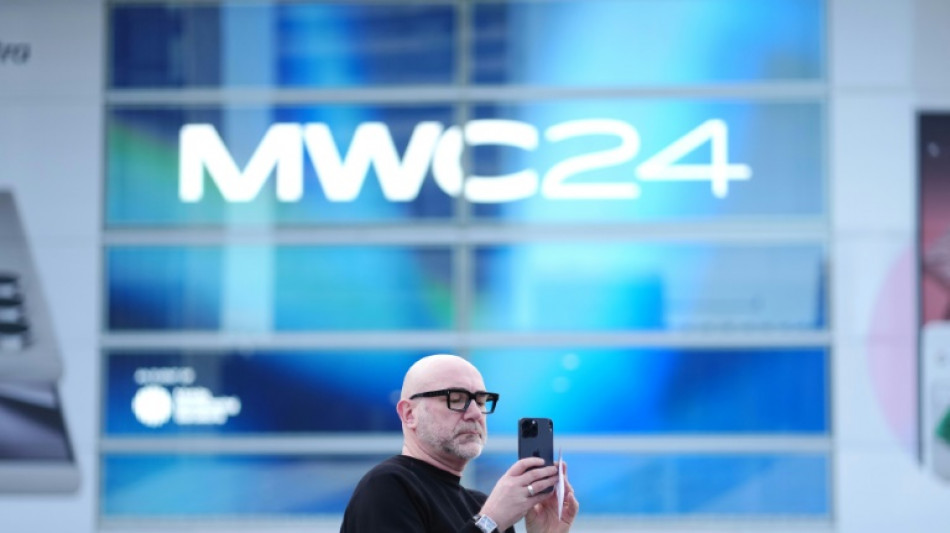
Smartphone makers bet on AI to revive sales / Photo: PAU BARRENA - AFP

 Mutual fund returns show shifting leaders across market-cap categories

 IndiGo holds talks with Embraer over potential order for 100 aircraft

 Indian companies report mixed second-quarter results on November 4

 KKR secures Indian regulator approval for Gentari Renewables investment

 Bharti Airtel revenue expected to grow at double-digit pace in second quarter

 Indian crude-sensitive shares gain after 13% oil-price decline

 Stocks and dollar fall as Democratic election gains reshape markets

 Qatar Tourism joins Pacific Asia Travel Association at London travel market

Smartphone makers are packing their latest devices with flashy new artificial intelligence tools such as real-time voice translation and advanced photo editing in efforts to reignite consumer demand.
The trend was on display at the telecom industry's biggest annual show, the four-day Mobile World Congress (MWC) which got under way Monday in Barcelona, where handset makers focused on the unique AI-powered features of their new flagship devices.
"Phones have just got boring, they are not as exciting as they used to be. The changes from one model to the next are not that great," Ben Wood, chief of researcher at CCS Insight, told AFP.
While cameras, battery life and screens are "a little better" than before, companies need to add more "exciting" capabilities to their products to encourage people to upgrade their phones, Wood added.
"AI is a way to do that," he said.
South Korean giant Samsung's stand at the MWC prominently plugged its new premium AI-powered Galaxy S24 range, which allow users to make or receive a call in a language they don't speak and then receive a live translation of the call both audibly and on the screen.
The feature can handle 13 languages, including French, Japanese and Hindi.
The new handsets -- which were launched in January -- also includes an AI-powered photo editing tool that allows you to easily move and erase objects and people from photos, and then generates content to fill the empty spaces that match its surroundings.
- 'Changes everything' -
Smaller device makers are also betting heavily on AI.
China's Honor launched its new AI-infused flagship Magic 6 Pro smartphone in Barcelona which features a camera with motion-sensing capabilities that can detect and automatically photograph fast actions such as sports at the best moment.
It also includes AI-powered eye-tracking technology which allows users to control apps with their eyes -- without using their fingers -- which Honor demonstrated by using the phone to control a car hands-free.
"AI changes everything," Honor CEO George Zhao said, adding it "can make fantastic things happen."
Smartphone makers are now able to offer these sorts of AI-powered features -- often directly on the handset without resorting to more time-consuming and costly cloud computing -- because the computing power of AI chips has increased significantly, analysts said.
"This potentially could be the start of a new era for smartphones," said PP Foresight analyst Paolo Pescatore, adding the challenge for device makers will be to inform consumers about the new AI-powered tools.
"Articulating the merits of AI and the new features to users will be no easy feat. Not all users are necessarily aware of AI and they will be sceptical at first," he told AFP.
- 'Lack of growth' -
The focus on AI comes amid sluggish smartphones sales as consumers are taking longer to upgrade their devices due to a lack of significant innovations, high inflation and economic uncertainties.
Global smartphone shipments declined 3.2 percent to 1.17 billion units in 2023, its second consecutive yearly decline, according to the IDC consultancy which predicts a marginal rebound this year.
It predicts 170 million next-generation AI smartphones will be shipped in 2024, almost 15 percent of total smartphone shipments, up from roughly 51 million shipped in 2023.
"We are challenged by a lack of growth. So we need to look for opportunity," Mats Granryd, the director general of telecoms industry group GSMA, the event organiser, said in an opening address.
AI-powered tools could also become a new revenue stream for device makers. Samsung has hinted that it may introduce more powerful AI features in the future for paid subscribers.
"Everybody wants to drive a services revenue. They all look at Apple, particularly in the mobile phone business, and they are so jealous of Apple being able to generate so much revenue from a services model," said Wood.
Apple charges users of its iPhone for a variety of services such as extra cloud storage which has buoyed its profits.
M.Anderson--CPN