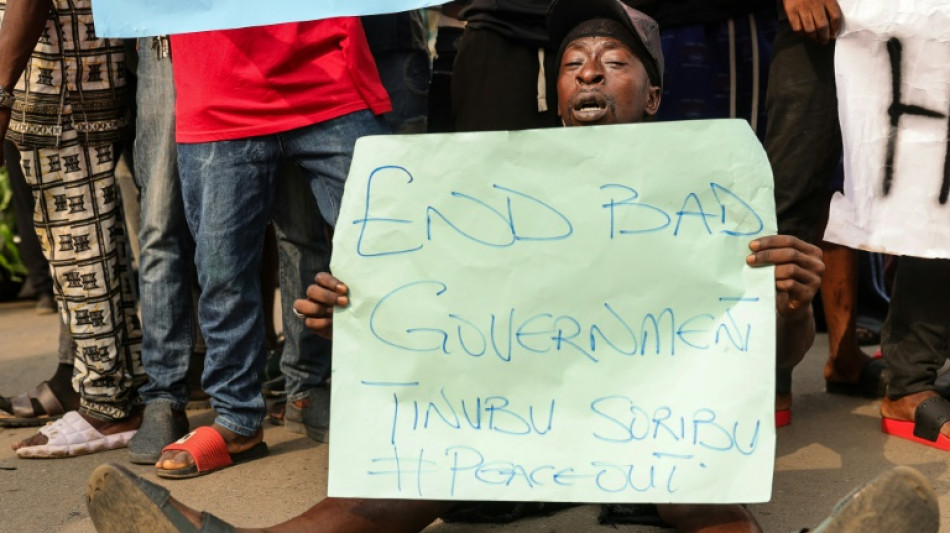
Lagos state intervenes to ease Nigeria cost of living crisis / Photo: SAMUEL ALABI - AFP/File

 Mutual fund returns show shifting leaders across market-cap categories

 IndiGo holds talks with Embraer over potential order for 100 aircraft

 Indian companies report mixed second-quarter results on November 4

 KKR secures Indian regulator approval for Gentari Renewables investment

 Bharti Airtel revenue expected to grow at double-digit pace in second quarter

 Indian crude-sensitive shares gain after 13% oil-price decline

 Stocks and dollar fall as Democratic election gains reshape markets

 Qatar Tourism joins Pacific Asia Travel Association at London travel market

The governor of Nigeria's Lagos state on Thursday unveiled a series of measures aimed at easing the soaring cost of living after protests broke out.
Nigeria is suffering an economic crisis with soaring inflation, leaving many people struggling to afford food.
Governor Babajide Sanwo-Olu, whose state includes the 20 million people of the city of Lagos, listed measures including a three-day working week for civil servants, a 25-percent reduction of public transport prices and the opening to price competition of 42 Sunday markets.
He also announced that 50,000 pregnant women would be exempted from health charges each year.
The intervention came after the Nigeria Labour Congress (NLC) last week called for national protests on February 27 and 28 against the cost of living.
Many poor Nigerians have had to give up products considered a luxury, such as meat, eggs and milk.
Protests have already taken place this month in numerous places including Suleja, near the capital Abuja, Minna in Niger state and Kano.
On Monday, hundreds demonstrated in the southwestern city Ibadan voicing anger with President Bola Ahmed Tinubu's leadership, an AFP journalist at the scene reported.
Protesters carried placards saying "End bad government", "End food scarcity" and "End Nigerian hardship".
Since coming to office last year Tinubu ended fuel subsidies and currency controls, leading to a tripling of petrol prices and a spike in living costs as the naira slid against the dollar.
He has repeatedly called for patience to allow his reforms to take effect, saying they will help attract foreign investment, but the measures have hit Nigerians hard.
The nation's inflation rate reached almost 30 percent in January, according to the national bureau of statistics.
X.Cheung--CPN