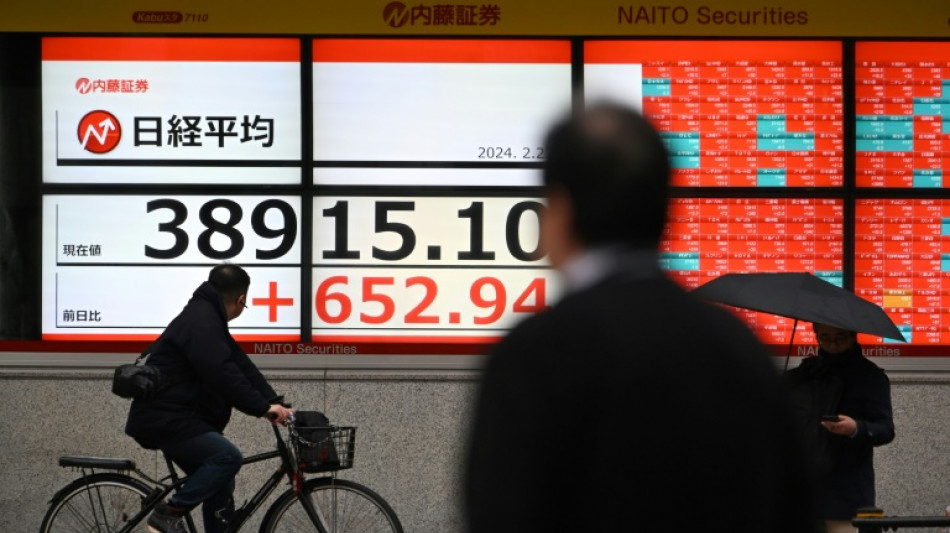
Japan's Nikkei breaks bubble-era record / Photo: Kazuhiro NOGI - AFP

 Mutual fund returns show shifting leaders across market-cap categories

 IndiGo holds talks with Embraer over potential order for 100 aircraft

 Indian companies report mixed second-quarter results on November 4

 KKR secures Indian regulator approval for Gentari Renewables investment

 Bharti Airtel revenue expected to grow at double-digit pace in second quarter

 Indian crude-sensitive shares gain after 13% oil-price decline

 Stocks and dollar fall as Democratic election gains reshape markets

 Qatar Tourism joins Pacific Asia Travel Association at London travel market

Japan's blue-chip Nikkei 225 on Thursday finally broke through a record high set just before the country's asset bubble catastrophically burst in the early 1990s.
At 12:31 pm (0331 GMT), the Nikkei was at 39,007.79, beating the record of 38,957.44 set on December 29, 1989.
Between 1985 and 1989, the Nikkei almost quadrupled in value while supported by low interest rates. Property prices also soared.
Tokyo property prices reached hundreds of times more than in Manhattan, golf club memberships would cost millions of dollars and bankers would sprinkle gold dust into their drinks.
Flush with cash and aided by the strength of the yen, Japanese companies also went on an overseas shopping spree, with Sony taking over Columbia Pictures and Mitsubishi purchasing New York's landmark Rockefeller Center.
But in the early 1990s came a crash as investors fled in panic, with the Nikkei roughly halving in 1990 and real estate prices falling even more as the Bank of Japan hiked borrowing costs.
This ushered in Japan's "lost decades" of economic stagnation, deflation and ballooning national debt.
Its stock market was hit by global downturns such as the burst of the dot-com bubble in the early 2000s and the 2008-2009 financial crisis.
Shares began to gain momentum again in around 2013, picking up speed in recent months, but analysts say that this time valuations are much more reasonable than during the 1980s.
"Share prices are not so expensive compared to the 'bubble' years if you compare the data," Asuka Sakamoto, chief economist of Mizuho Research & Technologies, told AFP.
In recent months, in common with other markets around the world, the Nikkei has posted strong gains and on Thursday was boosted by bumper results by US chipmaker Nvidia.
Takahide Kiuchi, executive economist of Nomura Research Institute, said share prices have also been boosted by the Bank of Japan's refusal to move away from monetary easing policies, designed to boost the country's moribund economy.
Rises in stocks are backed by "expectations that the cheap yen will continue given the Bank of Japan's easing policies, which in turn will prompt a rise in prices and salaries", Kiuichi wrote in a report in February.
Even so, downward risks include less-than-expected salary rises in this year's annual spring wage negotiations and tightening of the BoJ's monetary policy as well as uncertainty about US interest rates, he noted.
P.Petrenko--CPN