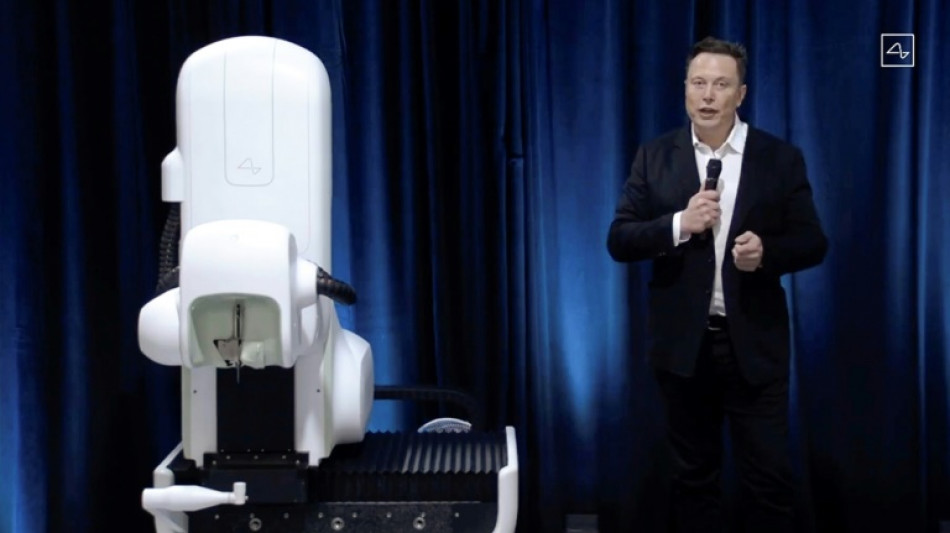
Musk says patient moves cursor with brain implant / Photo: - - Neuralink/AFP

 Mutual fund returns show shifting leaders across market-cap categories

 IndiGo holds talks with Embraer over potential order for 100 aircraft

 Indian companies report mixed second-quarter results on November 4

 KKR secures Indian regulator approval for Gentari Renewables investment

 Bharti Airtel revenue expected to grow at double-digit pace in second quarter

 Indian crude-sensitive shares gain after 13% oil-price decline

 Stocks and dollar fall as Democratic election gains reshape markets

 Qatar Tourism joins Pacific Asia Travel Association at London travel market

Elon Musk says the first human patient with a brain implant from his Neuralink startup is able to move a computer mouse with thought.
Last month, Musk's neurotechnology company installed a brain implant in its first human patient and on Monday Musk reported the experiment had been a success.
"The patient seems to have made a full recovery with no ill effects," Musk said in an interview streamed on X, formerly Twitter.
The patient is able to "move the mouse around the screen just by thinking," Musk said.
"We're trying to get as many button presses as possible from thinking," Musk added. "You want to have, obviously, more than just two buttons."
Neuralink's technology works through a device about the size of five stacked coins that is placed inside the human brain through invasive surgery.
The startup, cofounded by Musk in 2016, aims to build direct communication channels between the brain and computers.
The ambition is to supercharge human capabilities, treat neurological disorders like ALS or Parkinson's, and maybe one day achieve a symbiotic relationship between humans and artificial intelligence.
Musk is hardly alone in trying to make advances in the field, which is officially known as brain-machine or brain-computer interface research.
Hit with delays, the tycoon had reportedly reached out to join forces with implant developer Synchron.
The Australia-based Synchron implanted its first device in a US patient in July 2022.
P.Schmidt--CPN