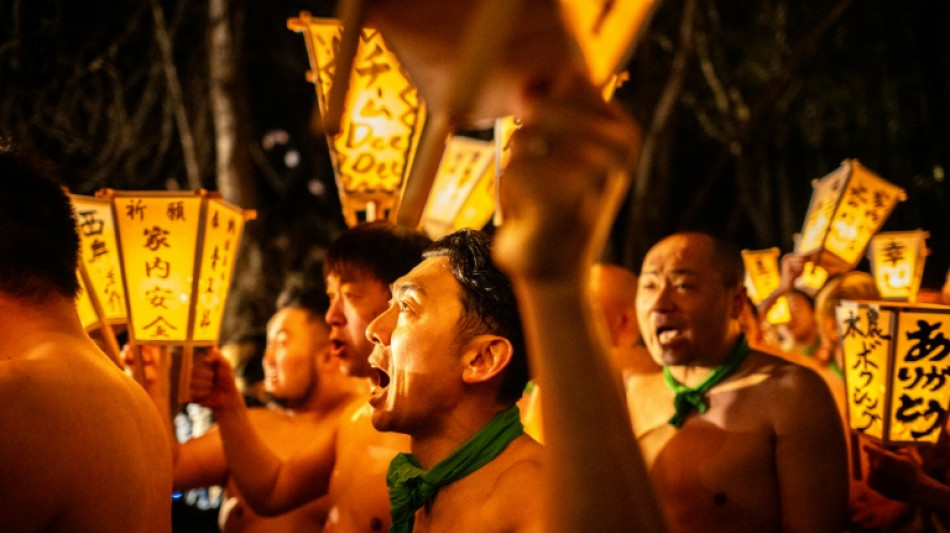
Japan's 'naked men' festival succumbs to population ageing / Photo: Philip FONG - AFP

 Mutual fund returns show shifting leaders across market-cap categories

 IndiGo holds talks with Embraer over potential order for 100 aircraft

 Indian companies report mixed second-quarter results on November 4

 KKR secures Indian regulator approval for Gentari Renewables investment

 Bharti Airtel revenue expected to grow at double-digit pace in second quarter

 Indian crude-sensitive shares gain after 13% oil-price decline

 Stocks and dollar fall as Democratic election gains reshape markets

 Qatar Tourism joins Pacific Asia Travel Association at London travel market

A steam of sweat rose as hundreds of naked men tussled over a bag of wooden talismans, performing a dramatic end to a thousand-year-old ritual in Japan that took place for the last time.
Their passionate chants of "jasso, joyasa" (meaning "evil, be gone") echoed through a ceder forest of the northern Japan's Iwate region, where the secluded Kokuseki Temple has decided to end the popular annual rite.
Organising the event, which draws hundreds of participants and thousands of tourists every year, has become a heavy burden for the ageing local faithful, who find it hard to keep up with the rigours of the ritual.
The "Sominsai" festival, regarded as one of the strangest festivals in Japan, is the latest tradition impacted by the country's ageing population crisis that has hit rural communities hard.
"It is very difficult to organise a festival of this scale," said Daigo Fujinami, a resident monk of the temple that opened in 729.
"I cannot be blind to the difficult reality."
- Ageing population -
Japan's society has aged more rapidly than most other countries'. The trend has forced countless schools, shops and services to close, particularly in small or rural communities.
Kokuseki Temple's Sominsai festival used to take place from the seventh day of Lunar New Year through to the following morning.
But during the Covid pandemic, it was scaled down to prayer ceremonies and smaller rituals.
The final festival was a shortened version, ending around 11:00 pm, but it drew the biggest crowd in recent memory, local residents said.
As the sun set, men in white loincloths came to the mountainous temple, bathed in a creek and marched around temple's ground.
They clenched their fists against the chill of a winter breeze, all the while chanting "jasso joyasa".
Some held small cameras to record their experience, while dozens of television crews followed the men through the temple's stone steps and dirt pathways.
As the festival reached its climax, hundreds of men packed inside the wooden temple shouting, chanting and aggressively jostling over a bag of talismans.
- Changing norms -
Toshiaki Kikuchi, a local resident who claimed the talismans and who helped organise the festival for years, said he hoped the ritual will return in the future.
"Even under a different format, I hope to maintain this tradition," he said after the festival.
"There are many things that you can appreciate only if you take part."
Many participants and visitors voiced both sadness and understanding about the festival's ending.
"This is the last of this great festival that has lasted 1,000 years. I really wanted to participate in this festival," Yasuo Nishimura, 49, a caregiver from Osaka, told AFP.
Other temples across Japan continue to host similar festivals where men wear loincloths and bathe in freezing water or fight over talismans.
Some festivals are adjusting their rules in line with changing democraphics and social norms so that they can continue to exist -- such as letting women take part in previously male-only ceremonies.
From next year, Kokuseki Temple will replace the festival with prayer ceremonies and other ways to continue its spiritual practices.
"Japan is facing a falling birthrate, ageing population, and lack of young people to continue various things," Nishimura said.
"Perhaps it is difficult to continue the same way as in the past."
Y.Ponomarenko--CPN