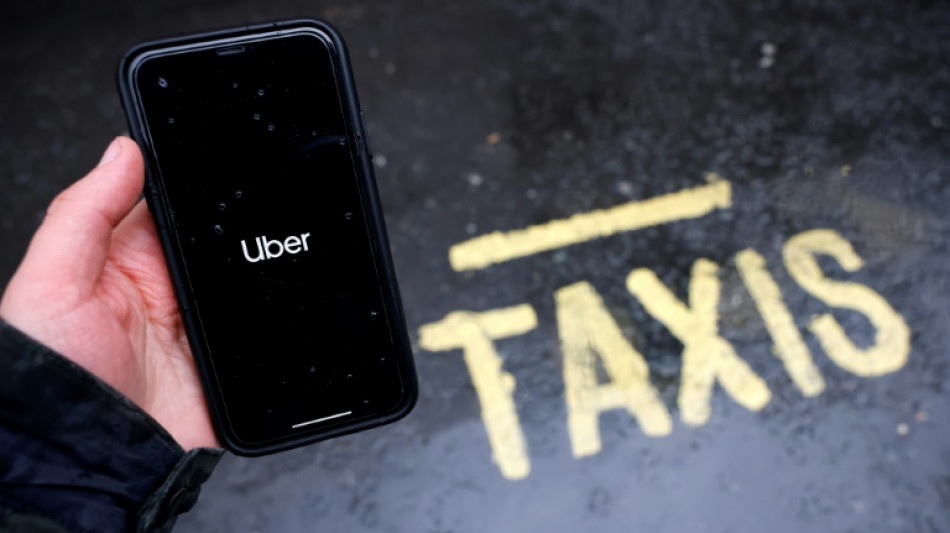
France, Germany block EU deal on scaled-back app worker law / Photo: Tolga Akmen - AFP/File

 Mutual fund returns show shifting leaders across market-cap categories

 IndiGo holds talks with Embraer over potential order for 100 aircraft

 Indian companies report mixed second-quarter results on November 4

 KKR secures Indian regulator approval for Gentari Renewables investment

 Bharti Airtel revenue expected to grow at double-digit pace in second quarter

 Indian crude-sensitive shares gain after 13% oil-price decline

 Stocks and dollar fall as Democratic election gains reshape markets

 Qatar Tourism joins Pacific Asia Travel Association at London travel market

France and Germany on Friday refused to back a watered-down agreement on controversial EU rules covering app workers in the gig economy, European diplomats said.
The European Union's objective was to bring in bloc-wide rules that supporters hoped would improve conditions for app workers in the gig economy by reclassifying some as employed.
But the latest text scaled back those efforts, by scrapping any formal list of criteria and letting states decide how to classify workers.
For any approval, there needed to be a qualified majority of 15 out of 27 EU nations, representing at least 65 percent of the bloc's population.
During a meeting of member states' ambassadors in Brussels, the EU's two most populous countries, France and Germany, blocked the text with the support of Estonia and Greece, the diplomats told AFP.
They said they could not support the text, therefore denying the qualified majority, the diplomats added.
"Unfortunately, the necessary qualified majority voting wasn't found," Belgium, which holds the rotating EU presidency, said on social media.
"We'll now consider the next steps," it added.
EU diplomats said the presidency would not give up. "Why would they? There are 23 countries supporting this deal," one said.
Others were sceptical, arguing that this would not be possible and the issue would be kicked into the long grass until after June elections across Europe.
The draft rules have been a source of controversy since the European Commission first proposed the text in 2021.
Member states and the European Parliament struck a first agreement on the draft text in December 2023 but days later, a France-led blockade stopped the deal in its tracks.
C.Peyronnet--CPN