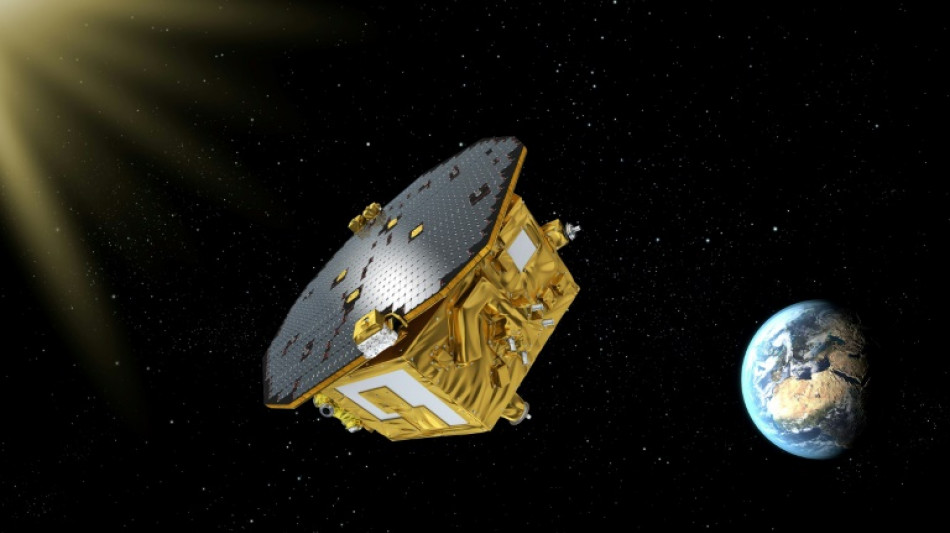
Gravitational wave, Venus missions get European green light / Photo: HO - ESA/AFP/File

 Qatar Tourism joins Pacific Asia Travel Association at London travel market

 Vessel operator seeks witnesses after Vancouver grounding

 Shrini Srivastava joins crew of Varanasi-Delhi Vande Bharat Sleeper service

 Nearly Half of Australian Workers Overqualified, Survey Finds

The European Space Agency gave the green light to two missions on Thursday, one to detect ripples in spacetime called gravitational waves and another to probe the secrets of Earth's closest neighbouring planet Venus.
The Laser Interferometer Space Antenna (LISA) will become the first mission to study gravitational waves from space, with a planned 2035 launch on an Ariane 6 rocket, the ESA said in a statement.
The mission will comprise three spacecrafts that will trail Earth as it orbits the Sun, forming an equilateral triangle in space.
Each side of the triangle will be 2.5 million kilometres, over which the three spacecrafts will exchange laser beams.
By measuring the slight distortions that gravitational waves make to the beams, the mission hopes to reveal their true nature and origin.
Predicted by Albert Einstein in 1916 but only observed for the first time a century later, gravitational waves are tiny distortions in the fabric of space-time which have been compared to ripples on the surface on a lake.
Formed by cataclysmic cosmic events such as the collision of two black holes, they travel through everything at the speed of light almost entirely unimpeded.
Their existence was not confirmed until 2015. Last year, scientists said they had found the first evidence of low-frequency gravitational waves, which are believed to be constantly rolling through space like background noise.
The ESA also officially approved the EnVision mission, which is planned to blast off towards Venus in 2031.
The mission hopes to gain new "important new insight into the planet's history, geological activity and climate," the ESA said.
It will be the first mission to directly probe beneath the surface of the inhospitably hot planet using radar technology, the ESA added.
EnVision also plans to launch on Europe's next-generation Ariane 6 rocket. After years of delays, the rocket is scheduled to have its maiden flight between June 15 and July 31 this year.
Y.Uduike--CPN