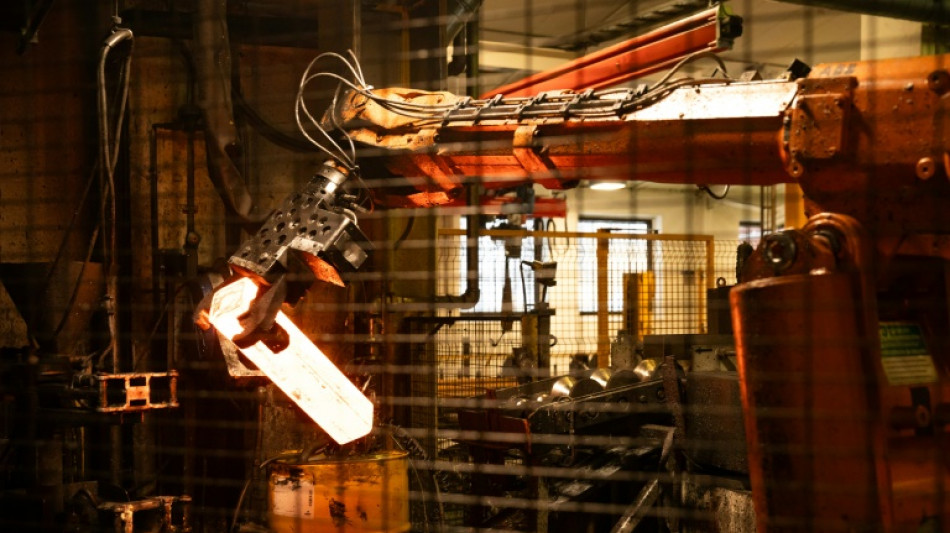
Norwegian factory gears up to supply ammunition to Ukraine / Photo: Petter Berntsen - AFP

 Qatar Tourism joins Pacific Asia Travel Association at London travel market

 Vessel operator seeks witnesses after Vancouver grounding

 Shrini Srivastava joins crew of Varanasi-Delhi Vande Bharat Sleeper service

 Nearly Half of Australian Workers Overqualified, Survey Finds

 RBI eases export-declaration compliance for individual service exporters

 Reliance shares remain in focus after near-12% surge

 Coal India prepares possible $1 billion Mahanadi Coalfields listing
Around the clock, glowing slabs of steel move from one machine to the next in a Norwegian factory producing artillery shells desperately needed by Ukraine.
Nordic countries have stepped up efforts to supply much needed ammunition to the Ukrainian war effort.
With both sharing a border with Russia, Norway and Finland were spooked by the Russian 2022 invasion of Ukraine.
Finland and Sweden also abandoned decades of military non-alignment and applied to join NATO -- though Sweden's application still awaits ratification by Hungary and Turkey. Norway was already a member.
Largely controlled by the Norwegian and Finnish states, Nammo is -- along with Germany's Rheinmetall, France's Nexter and the UK's BAE Systems -- one of the leading manufacturers of 155mm artillery shells in Europe.
In Raufoss, some 100 kilometres (62 miles) north of Oslo, its factory is producing shell cases "non-stop", which will then be filled with explosives elsewhere.
"As long as we have the right machines and the right operators, there are no limits to the specifications we can meet," process engineer Sigbjorn Overboe explains.
"Precision can be down to the micron (one millionth of a metre)".
But the process, which includes several stages of treating the metal, is relatively slow, and therefore struggles to keep up with the rate of consumption in Ukraine.
- New production line -
To speed up production, Norway announced last week that it would invest 2 billion kroner ($191 million) to boost its ammunition and missile production capacity.
"It is absolutely necessary to increase European production," Norwegian Prime Minister Jonas Gahr Store told AFP.
"We have had many years of reducing the European weapons industry. The war in Ukraine reminds us that this has to increase again," he added.
Half of the funds will go to purchasing a new press and new machining tools, so that Nammo can open an additional shell production line.
"With that, we will quintuple our artillery production capacity," Morten Brandtzaeg, CEO of Nammo, told AFP.
"We prefer not to specify volumes, because there may be prying eyes, but we will soon be producing more".
Finland and Sweden have also dedicated funds to boost production at Nammo sites on their territory.
But the needs are enormous, both to supply Ukraine and to replenish stocks of Western militaries.
Ukraine fires around 200,000 shells a month, according to experts.
- Competition with cat videos -
While the EU has set a target of supplying Ukraine with one million rounds by the end of March, only 300,000 shells have officially been delivered so far.
"We're not there yet in Europe, we're 50 percent behind schedule", risk consultant Stephane Audrand explained. "And American aid is becoming very uncertain".
"There has been an effort and some announcements in recent weeks, but there is also a lot of competition between manufacturers for supplies and materials such as cotton linter used for charges of propellant", he noted.
In addition to supply chain bottlenecks, ammunition production can also be snagged by other difficulties, such as access to energy.
Last year, Brandtzaeg warned that the planned expansion of the Raufoss factory would require a volume of electricity already promised to a data centre being built for the Chinese app TikTok.
"We're banking on the fact that we'll have enough electricity," he says today. "And if someone also wants to devote energy to cat videos, so be it".
In any case, it will be some two years before the investments in Raufoss translate into more ammunition in the Ukrainian theatre.
"It's very important for Ukraine to know that somewhere down the road they will have increased supplies," a Norwegian official said on condition of anonymity.
"But in the meantime, it is clear that it will still be American ammunition stocks that will make the biggest contribution to feeding the machine".
M.García--CPN