World's richest five men double fortune since 2020: Oxfam / Photo: Olivia BUGAULT, Anibal MAIZ CACERES - AFP

 Qatar media bodies discuss support for humanitarian initiatives

 Bezos grant helps Seattle nonprofit move thousands of families toward housing

 US stocks fall before midterm Election Day as technology shares weaken

 BLS Polymers makes strong market debut at ₹248 per share

 Petrol and diesel prices remain broadly steady across major Indian cities

 Derek Tierney Outlines Ten-Year Strategy for National Digital Health System

 BLS Polymers shares open 65.3% above IPO price

 ITC shares rise as analysts anticipate gradual cigarette-business recovery

 The Digital Burden: Why Instant Messaging Feels Like a Full-Time Job
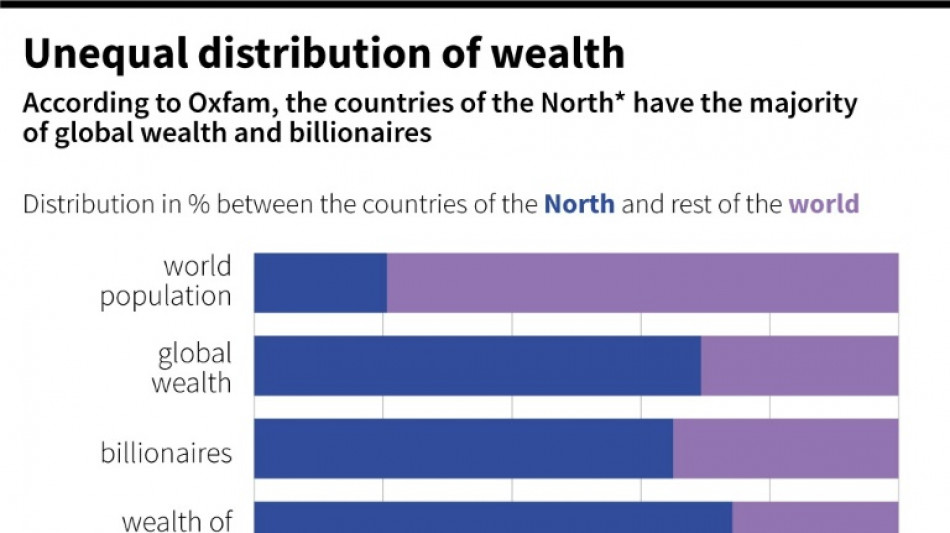
The world's wealthiest five men have more than doubled their fortune since 2020, the charity Oxfam said on Monday, as it called on nations to resist the ultra-rich's influence over tax policy.
A report from the charity, published as the global elite hobnob at the World Economic Forum in Davos this week, said their wealth rose from $405 billion in 2020 to $869 billion last year.
Yet since 2020, nearly five billion people worldwide have grown poorer, Oxfam said.
Billionaires are today $3.3 billion richer than they were in 2020, despite many crises devastating the world's economy since this decade began, including the Covid pandemic.
Oxfam's yearly report on inequality worldwide is traditionally released just before the forum opens on Monday in the Swiss Alpine resort.
The charity raised concerns over increasing global inequality, with the richest individuals and companies amassing greater wealth thanks to surging stock prices, but also significantly more power.
"Corporate power is used to drive inequality: by squeezing workers and enriching wealthy shareholders, dodging taxes, and privatising the state," Oxfam said.
It also accused corporations of driving "inequality by undertaking a sustained and highly effective war on taxation", with far-reaching consequences.
Oxfam said states handed power over to monopolies, allowing corporations to influence the wages people are paid, food prices and which medicines individuals can access.
"Around the world, members of the private sector have relentlessly pushed for lower rates, more loopholes, less transparency, and other measures aimed at enabling companies to contribute as little as possible to public coffers," Oxfam added.
The charity said thanks to intensive lobbying over tax policymaking, corporations have been able to pay lower corporate taxes, thereby depriving governments of money that could be used to financially support the poorest in society.
Corporate taxes have significantly dropped in OECD countries from 48 percent in 1980 to 23.1 percent in 2022, Oxfam noted.
To address the imbalance, Oxfam called for a wealth tax on the world's millionaires and billionaires that it says could bring in $1.8 trillion dollars each year.
The charity also called to cap CEO pay and break up private monopolies.
U.Ndiaye--CPN