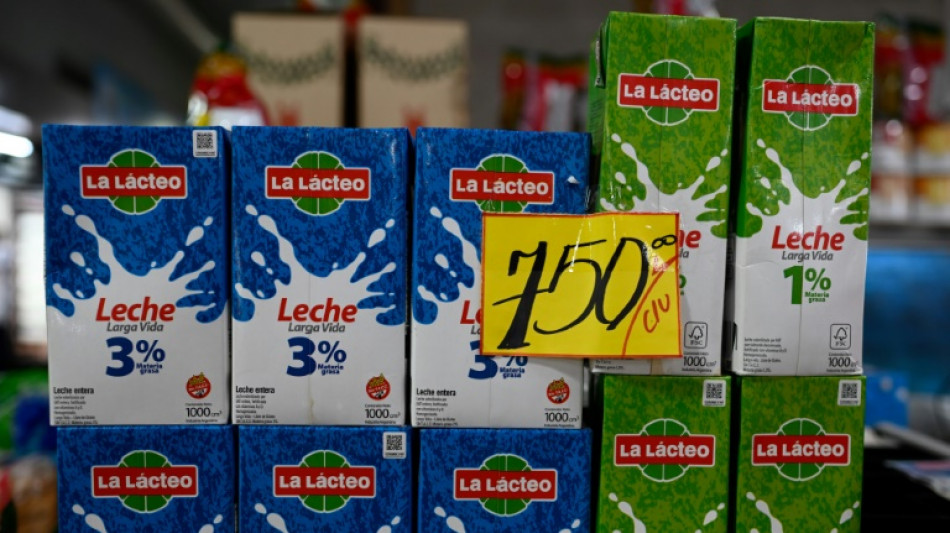
2023 inflation tops 211 percent in economic crisis-torn Argentina / Photo: Luis ROBAYO - AFP

 Qatar media bodies discuss support for humanitarian initiatives

 Bezos grant helps Seattle nonprofit move thousands of families toward housing

 US stocks fall before midterm Election Day as technology shares weaken

 BLS Polymers makes strong market debut at ₹248 per share

 Petrol and diesel prices remain broadly steady across major Indian cities

 Derek Tierney Outlines Ten-Year Strategy for National Digital Health System

 BLS Polymers shares open 65.3% above IPO price

 ITC shares rise as analysts anticipate gradual cigarette-business recovery

 The Digital Burden: Why Instant Messaging Feels Like a Full-Time Job
Argentina's annual inflation surged beyond 200 percent in 2023, the statistics agency said Thursday, as the country grapples with an economic crisis new President Javier Milei has vowed to address by slashing state spending.
Monthly inflation in December stood at 25.5 percent, said the INDEC agency, while the annual figure over 12 months was 211.4 percent.
Milei took office in December after winning a resounding election victory on a wave of fury over the country's decades of economic crises marked by debt, rampant money printing, inflation and fiscal deficit.
Shortly after the self-described "anarcho-capitalist" took office, his administration devalued Argentina's peso by more than 50 percent and announced huge cuts in generous state subsidies of fuel and transport.
His government has also done away with a program to control the prices of some goods, introduced by the previous government to try and ease the impact of inflation.
The International Monetary Fund (IMF) -- to which Argentina owes $44 billion -- welcomed these measures.
Milei has warned the country is on the brink of hyperinflation, and said economic "shock" treatment was the only solution.
Poverty levels in Latin America's third-biggest economy are at 40 percent.
- Milk money -
The INDEC said food and non-alcoholic drink prices rose more than 251 percent year-on-year, the single-biggest contributor to the annual inflation rate.
In the month to December, the increase in this sector was 29.7 percent, with meat, bread and cereal prices the main contributors, it said.
Health care costs rose year-on-year by more than 227 percent and transport 187 percent.
Economist Hernan Letcher said the main driver of December inflation was "the exchange rate" of the peso to the US dollar, alluding to the devaluation of the currency.
The official rate was 835 pesos to the dollar Thursday, or 1,120 pesos on the parallel exchange market.
"Usually, when there is a devaluation... there is a direct effect on prices. And wages tend to update later. That is why there is a loss of purchasing power," said Letcher, director of the Center for Argentina Political Economy (Cepa).
At markets on the outskirts of Buenos Aires, resignation reigned.
"We can't even drink milk given the price of a liter," said Maria Ester Espindola, a 65-year-old retiree.
Argentines remain haunted by hyperinflation of up to 3,000 percent in 1989-1990 and a dramatic economic implosion in 2001.
Ana Albornoz, a 53-year-old nanny, likened her shopping these days to a treasure hunt.
"Before, I went to one supermarket, now I go to several places to compare" prices, she told AFP.
A.Agostinelli--CPN