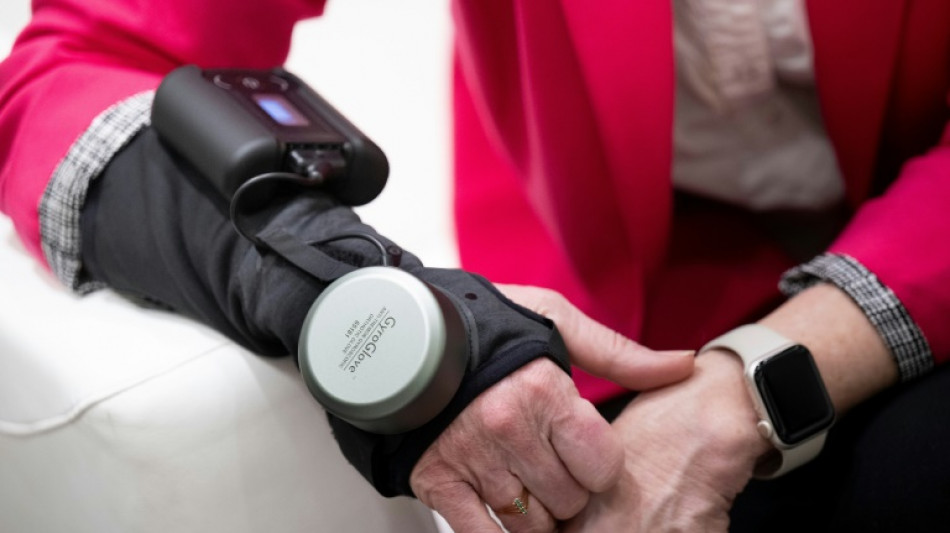
High tech glove stymies Parkinson's disease tremors / Photo: Brendan Smialowski - AFP

 Qatar media bodies discuss support for humanitarian initiatives

 Bezos grant helps Seattle nonprofit move thousands of families toward housing

 US stocks fall before midterm Election Day as technology shares weaken

 BLS Polymers makes strong market debut at ₹248 per share

 Petrol and diesel prices remain broadly steady across major Indian cities

 Derek Tierney Outlines Ten-Year Strategy for National Digital Health System

 BLS Polymers shares open 65.3% above IPO price

 ITC shares rise as analysts anticipate gradual cigarette-business recovery

 The Digital Burden: Why Instant Messaging Feels Like a Full-Time Job
Roberta Wilson-Garrett looked at the glove keeping her right hand steady and smiled.
At bay for the moment were tremors caused by Parkinson's disease affecting her muscle control.
She could do things others take for granted, like write crisply with a pen or hold a cup of coffee without spilling.
The reprieve shared by the Canadian woman at the Consumer Electronics Show (CES) in Las Vegas came thanks to a GyroGlove.
"It's a life changer for me," said Wilson-Garrett, describing how GyroGlove stopped tremors that make seemingly simple tasks like getting dressed a challenge.
GyroGear has built the world's most advanced hand stabilizer, with strategic partners that include Chinese technology group Foxconn, according to founder Dr. Faii Ong.
The key to GyroGlove is an attached gyroscope about the size of a hockey puck but with a disk inside that spins faster than a jet engine turbine, according to Ong.
"That glove is made in the same factory that makes your MacBook Pros," Ong said, referring to Foxconn being a supplier for Silicon Valley superstar Apple.
The plan is to miniaturize the gyroscope with future iterations of the glove.
"We want to bring the focus away from the disease and back onto the fact that this is human life we are talking about," Ong said.
"That is what tech should do; it's more important to focus back on ourselves as people and to understand how we can actually make people's lives better."
- Gadget guide dog -
Massachusetts-based GyroGear was one of an array of companies at CES seeking to use tech to improve life for people with infirmities or disabilities
Startups like Glidance and stalwarts like Amazon were among companies packed into a section of the Venetian hotel and casino displaying technology meant to improve life for people with disabilities.
Glidance founder Amos Miller, who lost his vision early in life, demonstrated a compact, two-wheeled device that acts as a guide dog of sorts for walkers who can't see.
Glide can be given a destination and lead the way for someone holding its handle, or be easily pushed along sensing obstacles and steering users along safe routes.
"You simply walk, and the wheels will steer," Miller told AFP as he demonstrated the device.
"I can tell it where to go if I want, but it will resist me bumping into anything."
The Seattle-based startup plans to launch a beta program for Glide later this year and make it as easy to afford as a smartphone.
Another Seattle startup called OneCourt has created what looks like a toy sized replica of an American football field which converts real-time updates from a sports match into vibrations.
Visually impaired sports fans can place a hand on the faux field to feel action playing out in a game.
The device can work with a gamut of sports including tennis, hockey, and American football.
"We're excited to be making live sports more accessible to people with visual disabilities," said OneCourt chief executive Jerred Mace.
"Basically, trying to get people closer to the action."
Vibrations on the device provide a sense of factors such as how fast a ball or puck is moving, where players are on a field and how they are maneuvering.
Mace hopes the yet-to-be released device will be made available through partnerships with teams or leagues, free for use by visually impaired fans at games.
Innovations on display at CES included technology-packed glasses for the blind from Lumen that let wearers know where it is safe to walk, even avoiding puddles.
There were glasses with frames that doubled as hearing aids as well as eyewear to offset visual impairments or even dyslexia.
Offerings from Israel-based Orcam included handheld scanners that read and even translate text for students with learning disabilities or young immigrants just learning English.
"Accessibility is the best use of technology," said Techsponential analyst Avi Greengart.
P.Schmidt--CPN