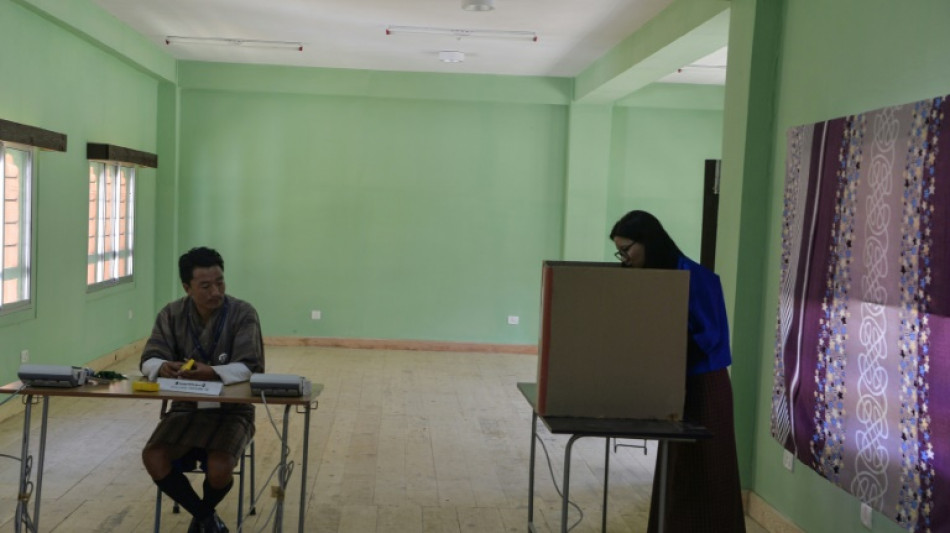
Bhutan to vote as economic strife hits 'national happiness' / Photo: DIPTENDU DUTTA - AFP

 Vessel operator seeks witnesses after Vancouver grounding

 Shrini Srivastava joins crew of Varanasi-Delhi Vande Bharat Sleeper service

 Nearly Half of Australian Workers Overqualified, Survey Finds

 RBI eases export-declaration compliance for individual service exporters

 Reliance shares remain in focus after near-12% surge

 Coal India prepares possible $1 billion Mahanadi Coalfields listing

 Capital-markets shares rally as Motilal Oswal and Angel One lead gains

 Reliance rally puts historical one-year return pattern in focus

 Saudi Aramco quarterly profit climbs 34.6% amid elevated oil prices

 Australia raises benchmark rate to highest level in 18 years

 Asian stocks retreat as AI worries outweigh steep oil-price drop

 Hamad International Airport stages emergency drills during WATAN 2026
The picturesque Himalayan kingdom of Bhutan holds general elections on Tuesday with serious economic challenges calling into question its longstanding policy of prioritising "Gross National Happiness" over growth.
Both parties contesting the vote are committed to a constitutionally enshrined philosophy of a government that measures its success by the "happiness and well-being of the people".
Some voters are expected to trek for days to cast their ballots in the landlocked and sparsely populated country, similar in size to Switzerland.
Foremost in the minds of many are the struggles facing the kingdom's younger generation, with chronic youth unemployment and a brain drain of migration abroad.
"We don't need more new roads or bridges," farmer Kinley Wangchuk, 46, told AFP. "What we really need is more jobs for young people."
Bhutan's youth unemployment rate stands at 29 percent, according to the World Bank, while economic growth has sputtered along at an average of 1.7 percent over the past five years.
Young citizens have left in record numbers searching for better financial and educational opportunities abroad since the last elections, with Australia the top destination.
Around 15,000 Bhutanese were issued visas there in the 12 months to last July, according to a local news report -- more than the preceding six years combined, and almost two percent of the kingdom's population.
The issue is front and centre for both parties contesting the poll.
Career civil servant Pema Chewang of the Bhutan Tendrel Party (BTP), said the country was losing the "cream of the nation".
"If this trend continues, we might be confronted with a situation of empty villages and a deserted nation," the 56-year-old added.
His opponent, former prime minister and People's Democratic Party (PDP) chief Tshering Tobgay, 58, sounded the alarm over Bhutan's "unprecedented economic challenges and mass exodus".
His party's manifesto quoted government statistics showing that one in every eight people were "struggling to meet their basic needs for food" and other necessities.
- Economic promises -
Tourism, a small share of Bhutan's economy but a key earner of foreign currency, has yet to recover from the disruptions of the coronavirus pandemic.
Last year, the government cut the substantial daily fee paid by foreign visitors to ensure the industry remains sustainable and prevent ecological harm.
But foreign tourist numbers in 2023 were only around a third of the 316,000 people who visited four years prior.
The previous government pursued several projects to diversify the economy, including a special economic zone on the Indian border and plans with a Singapore-based company to raise funds for a cryptocurrency-mining scheme.
Both parties have pledged a huge ramp-up of investment in hydropower, its primary source of energy.
The BTP manifesto said installed hydro capacity was just 10 percent of potential, with the PDP pledging the development of steel, cement and other support industries that would provide much-needed jobs.
Bhutan's mountain valleys and abundant water resources have created "ideal conditions" for hydropower development and export to India, according to the World Bank.
Nearby Nepal this week signed a lucrative hydropower deal to provide 10,000 megawatts over the coming decade to energy-hungry India, which is overwhelmingly dependent on coal but taking some tentative steps to decarbonise.
- Subdued campaigning -
Bhutan held elections for the first time in 2008 after political reforms established a bicameral parliament soon after the start of the reign of the present king, who remains hugely popular.
Campaigns in the Buddhist-majority nation have always been subdued affairs, with strict rules mandating that election materials can only be posted on public notice boards.
A primary contest in November narrowed the race down to two parties, with both the previous government's lawmakers and their former opposition knocked out.
The party of former prime minister Lotay Tshering, a doctor known for conducting surgeries on weekends as a "de-stressor" from the pressures of office, polled just 13 percent.
Bhutan has around 800,000 people and lies sandwiched between the two most populous countries, China and India.
Both neighbours are watching the vote with interest, as they eye strategic contested border zones.
A "cooperation agreement" was inked between Bhutan and China in October after talks over their disputed northern frontier sparked concern in India.
New Delhi has long regarded Bhutan as a buffer state firmly under its orbit, and effectively ran the country's foreign policy until 2007.
A.Mykhailo--CPN